

Paid Advertising12 min read
Spending on Google Ads? How to Know What’s Actually Working
Lessons from a real client meeting on Google Ads budgets, lead tracking, seasonal timing and landing pages, plus the questions to ask your agency every month.
- Written by
- Melissa Cross
- Published
- 14 October 2026
- Updated
- 27 October 2026
Most business owners I meet know roughly what they spend on Google Ads each month. Far fewer can tell me which campaigns brought in paying customers. That gap is where wasted budget hides.
This is the first edition of Behind the Brief, a series where I share what came up in a real client meeting at Online Marketing Help. No client names and nothing confidential, only the questions and the answers we gave. We manage Google Ads for UK businesses, so we know how easy it is for an agency to report clicks and leave it there.
Quick answer: Your Google Ads are working when you can trace the spend to enquiries, trace those enquiries to customers, and the revenue covers the cost with room to spare. Clicks and impressions can’t tell you that on their own. If your agency can’t show you which campaigns produce customers, you don’t yet know whether your ads work.
How does Google Ads spend your daily budget?
Google can spend more than your daily budget on a busy day, which surprises many people. Google Ads Help says a campaign “might spend up to twice your average daily budget” on a single day, and that across a month you will spend “no more than 30.4 times your average daily budget” (checked 25 October 2026). Quieter days balance out the busy ones.
| Average daily budget | Most on any one day | Most in a full month |
|---|---|---|
| £30 | £60 | £912 |
| £100 | £200 | £3,040 |
| £250 | £500 | £7,600 |
Worked out from Google’s 2x daily and 30.4x monthly limits. Media spend only, before any agency fee.
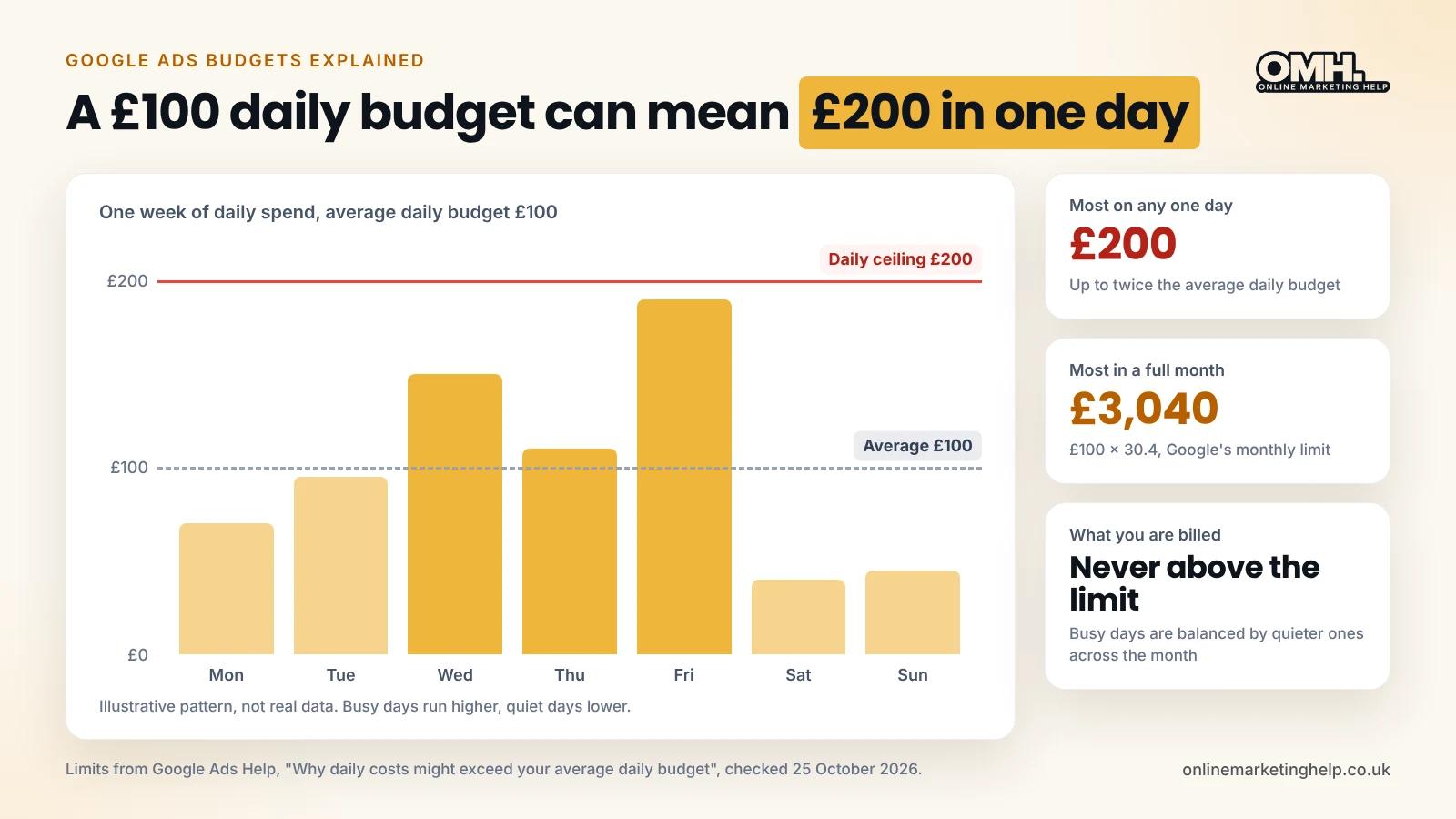
Take the middle row. A £190 Friday isn’t an overcharge if the month stays under £3,040. The mistake we see most is an owner finding out about that £190 day from a bank statement, because nobody told them to expect it.
Your Google media spend and your agency’s management fee are two separate costs. You should see both. Ours are on our price list. At the next review, ask your agency four things:
- What is our average daily budget, and what is the most we could spend this month?
- Which campaigns are getting most of that money?
- Has the budget changed since last month, and why?
- What did that spend produce in enquiries and sales?
Melissa’s Takeaway
Your marketing budget should never be something you simply hand over and hope for the best.
Transparency matters.
Your agency should help you understand where your money is going and why.
Which campaigns are your enquiries really coming from?
Most businesses we speak to run several channels at once: Google Ads, SEO, email, social media. Enquiries come in. Ask which campaign produced them, though, and you often get a shrug. A lead you can’t trace won’t tell you where next month’s budget should go.
Four tools close most of that gap:
- Google Analytics 4 (GA4) shows where your website visitors came from and which of them enquired.
- UTM tags add campaign labels to your links, so email and social traffic stops showing up as “direct”.
- Google Ads conversion tracking records actions that follow an ad. Google lists four types: website actions, app actions, phone calls from your ads, and offline conversions such as calls or visits after someone saw your ad.
- Your CRM records which enquiries became customers, and what they were worth.
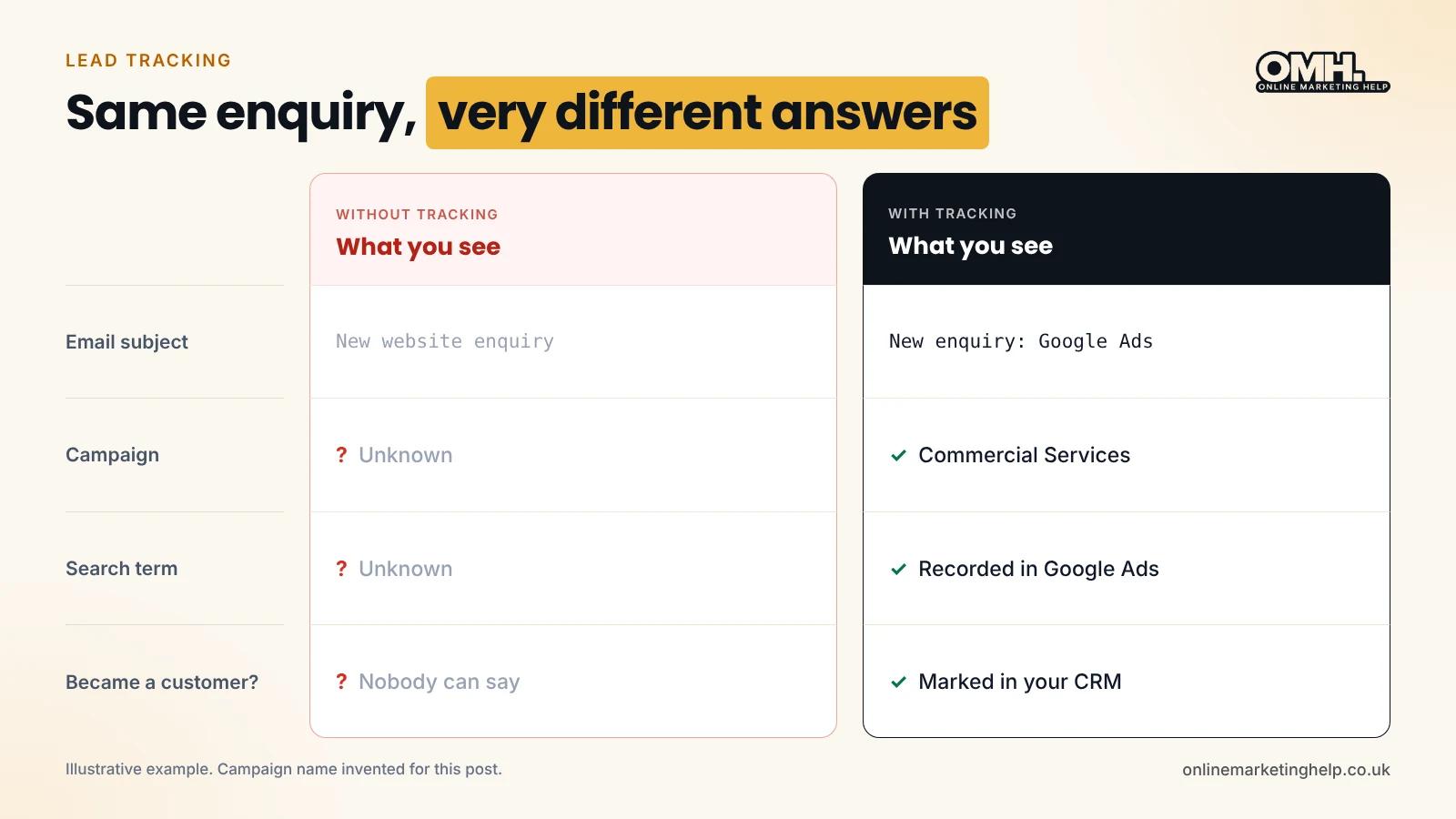
With all four in place, an email that used to say “New website enquiry” can tell you the enquiry came from Google Ads and from your commercial services campaign. Once your team marks it as won in the CRM, you can see what that campaign earns, not just how many forms it fills. Then you can decide which leads are worth paying for.
Melissa’s Takeaway
Don’t just ask how many leads your marketing is generating. Ask which campaigns are generating customers.
That’s where you start making better investment decisions.
What can tracking tell you, and what can’t it?
Tracking helps a lot. It still has gaps, and you should know where they are before you trust the numbers.
What tracking handles well
- Which campaigns, keywords and pages produce form fills and calls
- What each enquiry costs you, by campaign
- Which campaigns produce customers, once your CRM is kept up to date
- How results change month to month after you change something
What still needs a person
- People who see an ad, then call a week later from a different phone or after a friend’s recommendation
- Sales that close offline and never get recorded back against the lead
- Visitors who decline cookies, who will be missing from parts of your reports (see the UK rules section below)
- Lead quality. A tracked enquiry can still be a time-waster, and only your sales team knows that
A good report admits these gaps. If your agency’s numbers look too tidy, ask what they leave out.
Are your seasonal campaigns starting too late?
Your customers may start searching for your services long before you think they do. Launch your ads at the peak and someone else is already on the shortlist.
When should you start seasonal marketing?
It depends on your industry and how far ahead your customers decide. Businesses offering corporate Christmas events may find that customers start researching venues during the summer. Wedding suppliers often need enquiries many months before the big day. Garden businesses see people researching projects before spring. And if you sell a seasonal product, you need to know when demand starts to build, not only when it peaks.
Why does early marketing matter?
There are three main reasons:
- You reach people sooner. Customers who find you before your competitors are more likely to put you on their shortlist.
- You have time to improve your campaigns. An early launch lets you review the results and fix your adverts before the busy weeks arrive.
- Your SEO content has time to settle in. Search engines need time to find and process a new page, and rankings are never guaranteed, so publish seasonal pages well before you need the traffic.
How can you identify seasonal search trends?
Don’t guess. These sources show you when people start looking:
- Google Trends, for when interest in a search term starts climbing each year
- Google Search Console, for when your own pages start appearing in searches
- Google Ads Keyword Planner
- Your historical website analytics
- Last year’s enquiry dates
Melissa’s Takeaway
Don’t start marketing when your busy season begins. Start when your customers begin planning for it.
That small change in thinking could create significant opportunities.
Is your landing page wasting the clicks you pay for?
You pay for every click. A page that loses people wastes that money every single time. In our experience, these faults cost the most:
- The page doesn’t match the ad. Someone clicks an advert for one service and lands on your homepage.
- The offer isn’t clear. A visitor can’t tell what you do and for whom within a few seconds.
- There’s nothing to trust. No genuine reviews, credentials or a phone number in sight.
- The next step is hidden. No obvious button, or a form that asks for too much.
- It’s hard to use on a phone. Small buttons, slow loading and forms that fight the keyboard.
A plain page with a clear message often beats an elaborate one. There’s more on this on our website conversion page, and our free website audit will show you where yours loses people.
Melissa’s Takeaway
Getting someone to click your advert is only half the job.
What happens after that click is just as important.
Before spending more money on advertising, make sure your website is making the most of the visitors you’re already paying for.
Will a Wikipedia page help your SEO?
This question came up in the meeting, and the honest answer is that you can’t simply decide to have one. Wikipedia is an encyclopaedia, not a business directory, and its notability guideline for companies expects coverage in independent, reliable sources. Paying for publicity doesn’t make a business eligible.
The same goes for backlinks and content. More doesn’t automatically mean higher rankings. Genuine reviews, honest answers to the questions your customers ask, and clear information about who runs the business will do more for you. They help AI search tools understand you too, although nothing guarantees a mention in Google’s AI Overviews.
Melissa’s Takeaway
Don’t chase online visibility just for the sake of being visible.
Build a reputation that’s worth discovering.
UK rules on tracking your Google Ads visitors
This is where most American guides on the subject stop being useful.
Cookies and consent
Under PECR, the ICO’s guidance on storage and access technologies treats cookies used for advertising as needing consent. The Data (Use and Access) Act 2025 relaxed the rules for some first-party analytics that only help you improve your own site, but visitors must still be told and given a simple way to object. Google Ads conversion tracking and remarketing sit on the advertising side, so they belong behind your cookie banner.
What Google expects from UK advertisers
Google’s EU user consent policy covers users in the UK as well as the EEA. For UK traffic, Google says it does not expect verified consent signals through Consent Mode, but you still need consent for personalised ads and for cookies where the law requires it.
Enquiry and customer data
Names, phone numbers and emails in your CRM are personal data under UK GDPR. If you match sales back to campaigns, or upload customer data to Google Ads, your privacy notice should say so in plain words.
What should your agency tell you every month?
You run a business. You shouldn’t have to become a Google Ads expert to know whether your marketing works, and that’s what you pay an agency for. Each month, your report should cover:
- Where the money went: media spend and fees, by campaign
- What worked: the campaigns producing enquiries and customers
- What didn’t: an agency should be comfortable saying so
- What changes next: a recommendation, with the reason behind it
A good agency will push back sometimes, too. More budget rarely fixes a campaign that isn’t converting.
Melissa’s Takeaway
A good marketing agency shouldn’t simply manage your campaigns. It should help you make better business decisions.
That means having open conversations, asking difficult questions and being willing to change direction when the evidence supports it.
If you remember one thing from this edition, ask your agency these three questions this month: where is my budget going, which campaigns are bringing in customers, and what will you do differently next month based on what you’ve learnt? If those answers are hard to get, it’s time for a proper review.
Your marketing should be working for your business. Not the other way around.
Frequently asked questions
How do I know if my Google Ads are working?
Look past clicks and impressions. Check how many qualified enquiries each campaign produces, what each enquiry costs, how many become customers and whether the revenue covers your ad spend and fees. If you can’t trace an enquiry back to a campaign, fix your conversion tracking first, because every other figure depends on it.
Can Google Ads spend more than my daily budget?
Yes. Google says a campaign can spend up to twice its average daily budget on a single day. Across a full month, you won’t spend more than 30.4 times your average daily budget, so a £100 daily budget has a monthly ceiling of £3,040. Quieter days balance out the busy ones.
Do I need consent for Google Ads conversion tracking in the UK?
Usually, yes. The ICO treats cookies used for advertising as needing consent under PECR, and Google’s own consent policy covers UK users. Some first-party analytics can now run without consent, but advertising tracking is not part of that exemption. Check that your cookie banner actually controls your Google tags.
How often should I review my Google Ads with my agency?
Monthly suits most businesses, with closer contact during a launch, a test or a significant budget change. Each review should cover spend by campaign, enquiries and customers produced, what isn’t working and what will change next month. If a report gives you numbers without recommendations, ask for the recommendations.
Can a better landing page reduce wasted ad spend?
It can. A page that matches the advert, explains the offer quickly and works well on a phone usually turns more of your existing clicks into enquiries. Results still depend on your targeting, demand and the offer itself, so measure enquiries before and after any change rather than assuming it worked.
Want a second opinion on your Google Ads?
We manage Google Ads, SEO and websites for businesses across the UK, and we’re happy to look at what you have now. Book a free consultation if you’d like a plain-English review of your account, see our case studies for the kind of work we do, or read more about our Google Ads management.
Behind the Brief is a regular series by Melissa Cross, Managing Director of Online Marketing Help. Each edition shares lessons from real client conversations. Client identities and confidential details are always protected.
Keep reading
Related insights
Paid Advertising
Amazon Buy Box Lost: How We Investigated a UK Seller’s Featured Offer Problem
Lost your Amazon UK Buy Box? Explore a Seller Central case study covering Featured Offer troubleshooting, reference-price checks and practical next steps.
Read articlePaid Advertising
How Should You Select the Best Advertising Platform for Your Business in 2024?
Choosing the right advertising platform is crucial in 2024. Understand trends, AI, and the best advertising platform strengths to align with your business goals
Read articlePaid Advertising
How Much Should a Typical Small Business Spend on Advertising?
Discover how much a typical small business should spend on advertising. Explore factors, benchmarks, and case studies for effective advertising strategies.
Read articleTurn useful ideas into a practical growth plan.
Tell us what you want to improve and what you have tried so far. We will help you identify the clearest next step.
What happens next
- Review the current position
- Define the commercial objective
- Agree the work and measurement