
Paid Advertising9 min read
Why You Need a High-Converting Landing Page for Google Ads
Running Google Ads without a page built for that traffic is one of the most common ways UK businesses waste spend. Here is why it matters, what a weak page costs you, and what to check first.
- Written by
- Melissa Cross
- Published
- Updated
Your Google Ads are getting clicks. The enquiries are not following. In most accounts we look at, the ad is not the problem. The page the click lands on is.
We run Google Ads accounts and build the websites behind them, so we have no reason to blame one over the other. Even so, the mistake we see most is a weak landing page quietly costing more than a weak ad ever could.
Quick answer: You need a landing page for Google Ads, not your homepage, because the page affects how Google rates your ads, what you pay per click, and whether a stranger who clicked a paid ad trusts you enough to enquire. Without one, you are paying for clicks that land somewhere not built to convert them.
Why do Google Ads landing pages waste so much budget?
Paid traffic either becomes an enquiry on the page or it leaves, and most pages were never built for that job. Here is what the evidence says:
- Landing page experience is one of three parts of Quality Score, alongside expected clickthrough rate and ad relevance, according to Google Ads Help on Quality Score (checked November 2026)
- Higher quality ads and landing pages generally lead to lower costs and better ad positions, in Google’s own words on its ad quality help page (checked November 2026)
- 53% of mobile visitors leave a page that takes longer than three seconds to load, according to Google research reported by Marketing Dive in September 2016. It is an old figure, and visitors have not grown more patient since
- 8.18% was the average Google Ads conversion rate across industries in WordStream by LocaliQ’s benchmark report, covering April 2025 to March 2026, as reported by Search Engine Journal. The report does not say it is UK data
- 6.6% is the median landing page conversion rate across more than 41,000 landing pages in the Unbounce Conversion Benchmark Report 2024. Again, not UK specific
We could not find a reliable UK-wide benchmark for either of the last two. Use them as a rough steer, not a target.
What is a landing page for Google Ads?
A landing page for Google Ads is a page built for one ad group’s traffic and nothing else. After the click, it is the only part of the journey you fully control. The ad gets the click. Whether that click turns into a phone call is down to the page.
Your homepage has a different job. It serves everyone: new visitors, returning customers, job hunters, suppliers. A landing page is for the one person who searched for one thing and clicked on one promise.
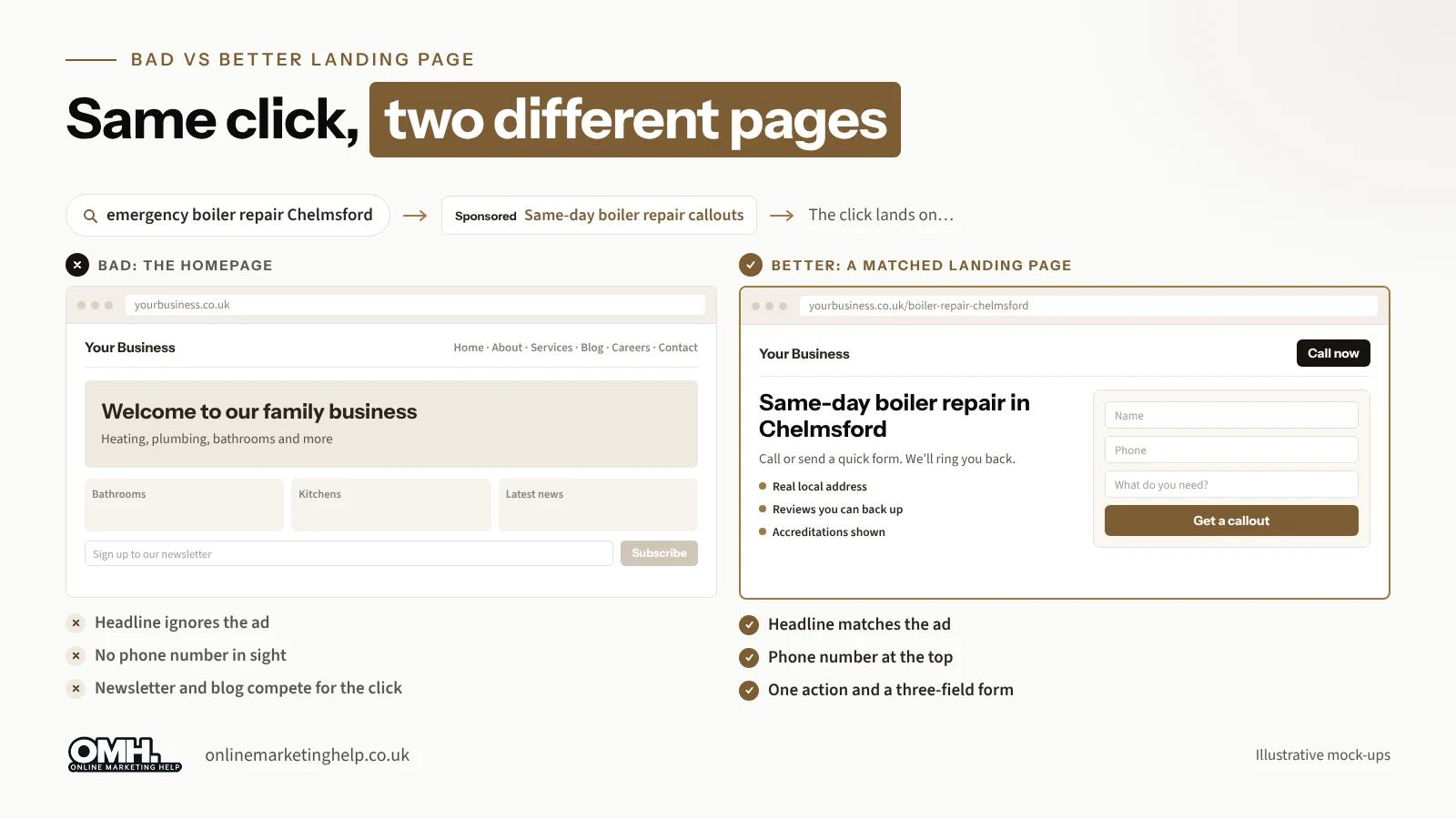
Here is what that looks like. Someone searches “emergency boiler repair Chelmsford” and clicks an ad promising same-day callouts. They land on a page whose headline says same-day boiler repair in Chelmsford, with a phone number at the top and a short form underneath. Not a homepage banner about how long you have been trading.
What a landing page can fix, and what it cannot
What it handles well
- A mismatch between what the ad promises and what the visitor finds
- A page that is slow to load, especially on a phone
- A form asking for too much, too soon
- Too few reasons for a stranger to trust a business they have never heard of
What still needs fixing elsewhere
- An offer nobody wants at the price you are charging
- Ads aimed at the wrong audience or the wrong keywords
- Conversion tracking that is not set up, so you cannot tell what is working
- A product or service that does not suit the person clicking
Rule these out before you spend a penny on a new page. A well-built page on top of a broken offer still will not convert. We would rather tell you that now than after the build.
What a weak landing page costs you
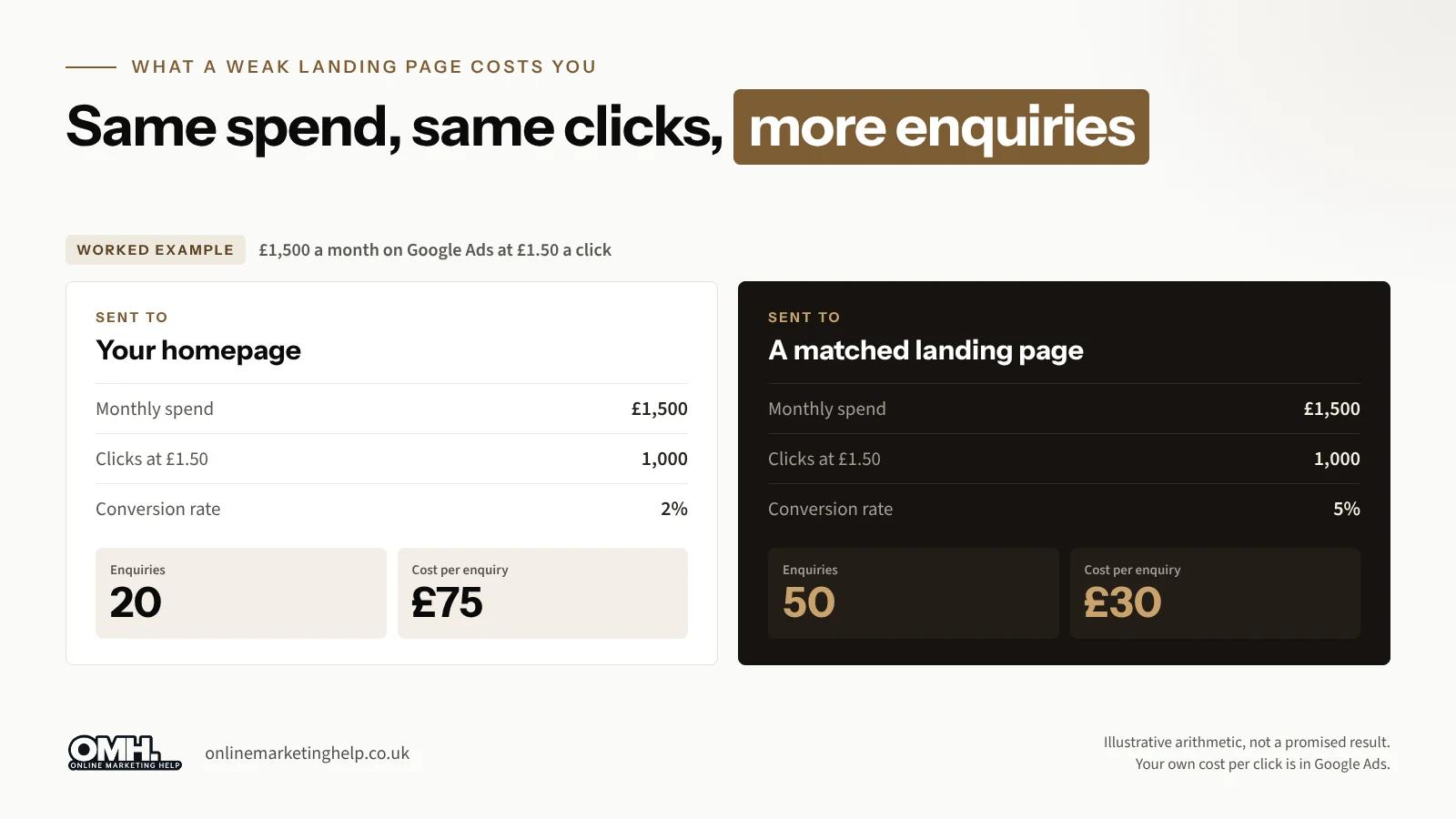
This is the arithmetic, not a promise of what you would see. A UK trades business spends £1,500 a month on Google Ads at £1.50 a click and gets 1,000 clicks. Sent to a general homepage converting at 2%, that is 20 enquiries at £75 each. Sent to a page that matches the ad, converting at 5% (below both benchmarks above), it is 50 enquiries at £30 each.
| Worked example | Sent to homepage | Sent to matched landing page |
|---|---|---|
| Monthly spend | £1,500 | £1,500 |
| Clicks at £1.50 | 1,000 | 1,000 |
| Conversion rate | 2% | 5% |
| Enquiries | 20 | 50 |
| Cost per enquiry | £75 | £30 |
The spend did not change. Neither did the clicks. Only the page did.
We used £1.50 to keep the sums simple. Your own average cost per click is in Google Ads, and it is probably different. The proportion between the two columns holds either way, because the page changes how many clicks become enquiries, not what each click costs today.
What a high-converting Google Ads landing page needs
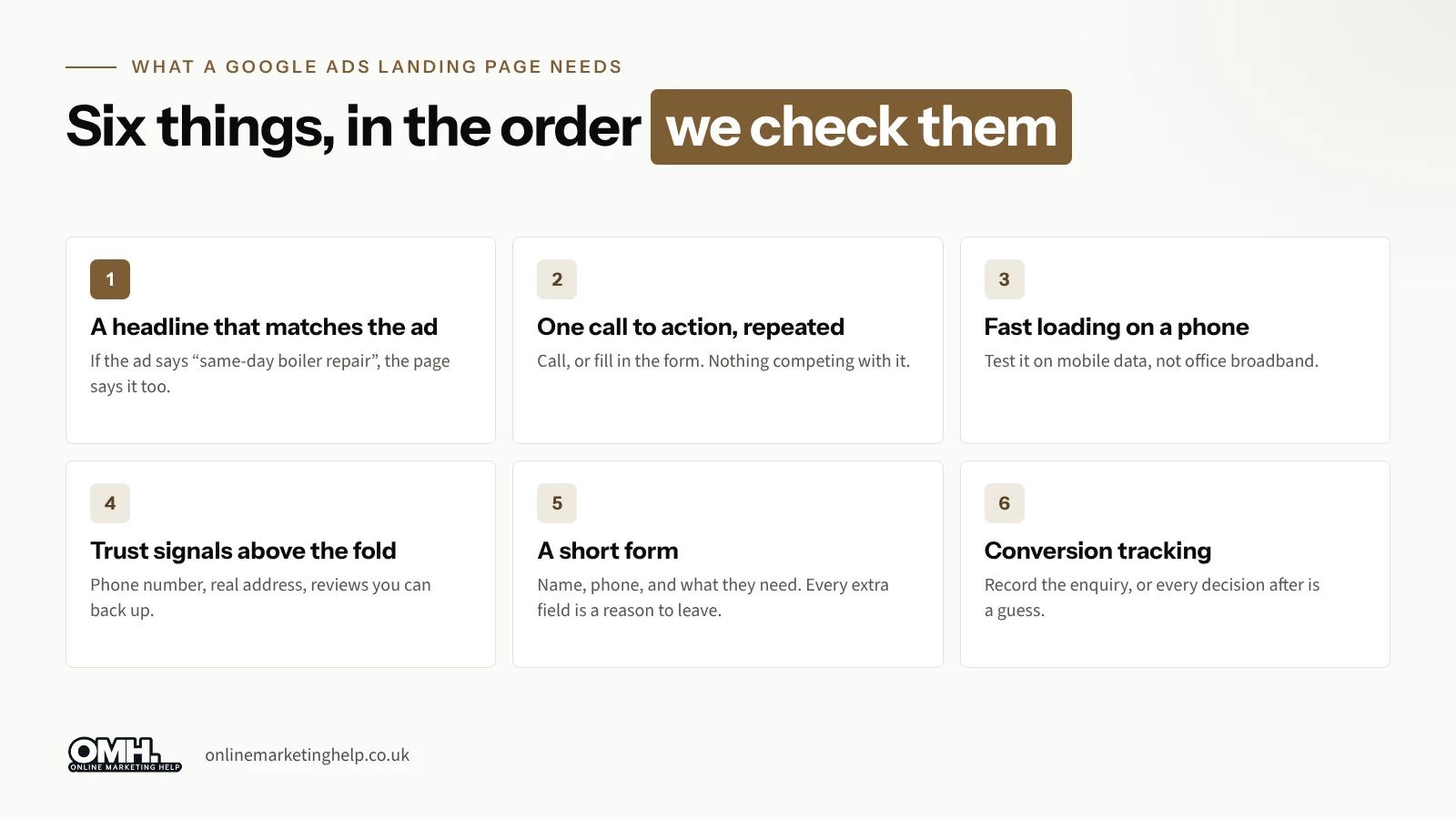
Six things, in the order we check them on a new account:
- A headline that matches the ad. If the ad says “same-day boiler repair”, the page says it too. Reusing the homepage headline is the most common mismatch we find.
- One call to action, repeated. Call, or fill in the form. Not both competing with a newsletter sign-up and a link to your blog.
- Fast loading on a phone. Test it on mobile data, not office broadband.
- Trust signals above the fold. A phone number, a real address, reviews or accreditations you can back up, and a line about who you are.
- A short form. Name, phone, and what they need. Every extra field is a reason to leave.
- Conversion tracking that records the enquiry. Without it, you cannot tell which page or ad is working, and every decision after that is a guess.
None of this needs a big budget. It needs someone to look at the page as the person who just clicked would.
Should you build it in WordPress, a landing page tool, or get it built?
All three work. If your site already runs on WordPress, that is where we would start, because the page will match the rest of the site and costs nothing extra to host.
| Option | Setup time | Ongoing cost | Best for |
|---|---|---|---|
| Build it in WordPress | A few days | Hosting you already pay for | Sites already on WordPress that want the page to match |
| A landing page tool | A few hours | A monthly licence on top | Testing several versions of a page quickly |
| Get it built | Depends on how many pages | Set by scope, quoted up front | Businesses without the time to learn a new tool |
We build landing pages, so take our row with the same pinch of salt you would take from anyone selling it. You can do the first two yourself if you have the time, and our write-up on building a landing page with Claude shows how far you can get yourself. For what we charge, see our pricing page.
Where to start if your Google Ads are not converting
You do not need a rebuild to see a difference. Start with these four checks:
- Check whether your ads send traffic to your homepage or to a dedicated page.
- Match the page headline to the ad that sent the click.
- Test the load time on a phone, not just a desktop.
- Make sure conversion tracking records what happens after the click.
If any of them fails, that is usually where the budget is going. Our guides on how to know if your Google Ads are working and whether your Google Ads are actually making you money cover the tracking side in more depth.
Keeping your landing page on the right side of UK law
Cookie and tracking consent
A Google Ads conversion tag or remarketing pixel is used for advertising, so it still needs clear, positive consent before it fires. The ICO finalised its updated guidance on storage and access technologies on 29 April 2026, and a banner that assumes consent by default does not meet it.
There is now a narrow exception for analytics used only to produce usage statistics for improving your site, with a simple, free way to opt out. Osborne Clarke’s May 2026 summary points out it is not a blanket analytics exemption, and it does not cover advertising. If one tool does both jobs, you need consent.
What you are allowed to say
Any claim on the page, whether a price, a turnaround time or “the UK’s leading”, has to be something you can back up. The CAP Code applies to a landing page exactly as it applies to the ad that sent someone there.
Handling the data people give you
A form asking for a name, email or phone number collects personal data under UK GDPR. Say what you will do with it. Never pre-tick a marketing consent box, and only ask for what you need to follow up.
Google Ads landing page questions
Why can’t I just send Google Ads traffic to my homepage?
You can, and plenty of businesses do. But a homepage is built for everyone, not to answer the promise in one ad. For paid traffic, a page that matches the ad gives the visitor a clearer next step, and that clear next step is what turns a click into an enquiry.
Does my landing page affect what I pay per click?
It can. Google says higher quality ads and landing pages generally lead to lower costs and better ad positions. The 1 to 10 Quality Score you see in your account is a diagnostic, not an input to the auction, but it shows you where the landing page is holding you back.
How many landing pages do I need?
One for each ad group selling something meaningfully different. Putting dissimilar offers on one page creates the mismatch that drags conversion rates down. A plumber running separate ads for boiler repair and bathroom fitting needs two pages.
What is a good conversion rate for a UK landing page?
There is no reliable UK-wide benchmark. Unbounce’s 2024 report puts the median landing page at 6.6%, and WordStream’s report puts the average Google Ads conversion rate at 8.18%, neither of them UK data. Measure your own baseline first and judge every change against that.
How long before I know if a new landing page is working?
In our experience, two to four weeks of live traffic with conversion tracking in place is usually enough to see a real difference. Low-volume accounts take longer, because you need enough clicks for the numbers to mean anything.
Not sure whether it is the page or the campaign?
We manage Google Ads accounts and design the websites behind them, so we see this from both sides. If your clicks are not turning into enquiries, a free website audit will show whether the page or the campaign is the weaker link. You can also see how we improve website conversion, read how we rebuilt a B2B manufacturer’s campaign in week two, or talk to the team.
Keep reading
Related insights
Paid Advertising
How to Improve Your Amazon IPI Score (From a Real Account Audit)
A real UK seller account scored 669 on Amazon’s Inventory Performance Index, yet three of its four factors carried warnings. Here is what the score measures, what it misses, and the five steps we use to fix it.
Read articlePaid Advertising
Your Agency Says Your Google Ads Are Performing. But Are They Actually Making You Money?
Plenty of Google Ads enquiries but no rise in sales? Behind the Brief Edition 002 shows how to check cost per lead, customer acquisition cost, ROI and ROAS, so you know whether your ads are making you money.
Read articlePaid Advertising
How We Launched Google Ads for a B2B Manufacturer on £1,500 a Month (And Rebuilt a Dead Campaign in Week Two)
How we launched Google Ads for a UK B2B manufacturer on £1,500 a month, and rebuilt a dead campaign in week two.
Read articleTurn useful ideas into a practical growth plan.
Tell us what you want to improve and what you have tried so far. We will help you identify the clearest next step.
What happens next
- Review the current position
- Define the commercial objective
- Agree the work and measurement
Ring it from any phone
It's set up as a fictional heating company in Leeds and answers day and night. Standard call rates apply.
The demo line is being set up.Book a demo and we'll play you one on the call.
Three things to try
- 1Book a boiler service for next week.
- 2Ask to speak to a person.
- 3Ask something it can't know, and hear how it handles it.