
Paid Advertising10 min read
Your Agency Says Your Google Ads Are Performing. But Are They Actually Making You Money?
Plenty of Google Ads enquiries but no rise in sales? Behind the Brief Edition 002 shows how to check cost per lead, customer acquisition cost, ROI and ROAS, so you know whether your ads are making you money.
- Written by
- Melissa Cross
- Published
- Updated
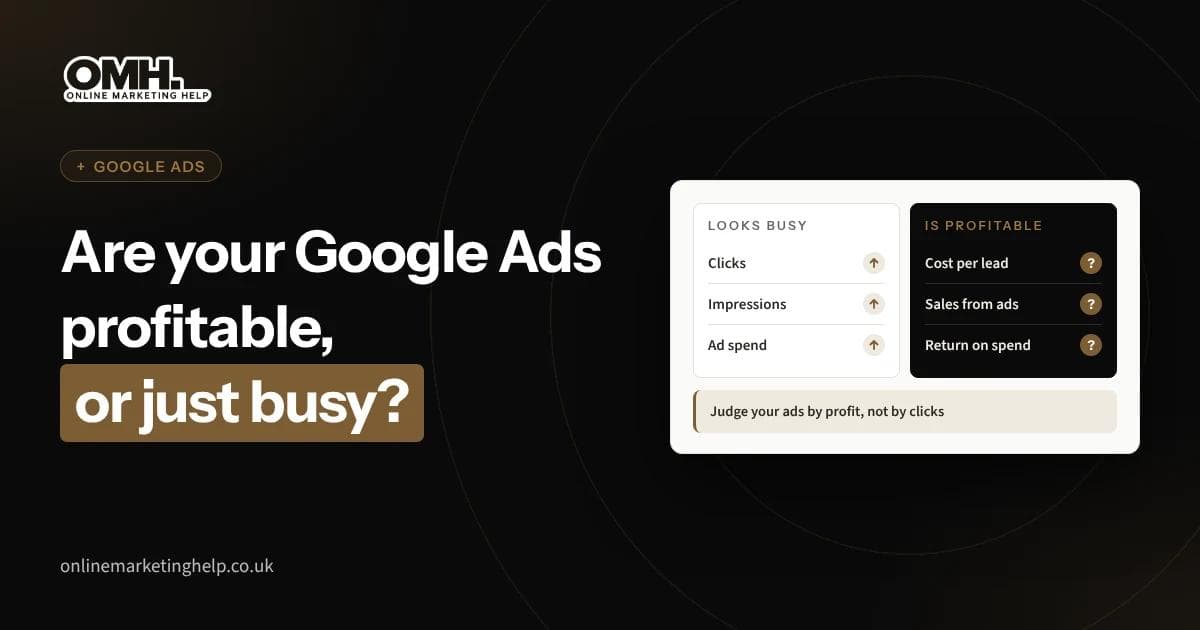
Are Google Ads profitable for your business? The answer depends on more than clicks, impressions or the number of enquiries appearing in your inbox.
To understand whether your campaigns are actually making money, you need to measure lead quality, customer conversion rates, acquisition costs and the profit generated from each new customer.
You need to understand:
- How much you're spending on advertising
- How many qualified enquiries you're generating
- How many enquiries become paying customers
- How much revenue those customers generate
- What profit remains after advertising and other relevant costs
Because here's something I think every business owner should understand.
A Google Ads campaign can look fantastic on paper and still be losing your business money.
And that's what we're exploring in this week's Behind the Brief.
Why can more Google Ads leads mean less profit?
Because leads are not sales. A campaign that brings in lots of cheap enquiries from the wrong people can cost you far more per customer than a smaller campaign that reaches the right ones.
Here is a simple comparison. The figures are illustrative, not client results.
| Measure | Campaign A | Campaign B |
|---|---|---|
| Ad spend | £1,000 | £750 |
| Enquiries | 100 | 25 |
| Cost per lead | £10 | £30 |
| New customers | 2 | 10 |
| Lead to customer rate | 2% | 40% |
| Ad cost per customer | £500 | £75 |
Campaign A brought in four times as many enquiries. Campaign B won five times as many customers, and spent £250 less doing it. You would still need the profit per customer before calling a winner, but the cheaper lead was clearly not the better one.
A qualified lead is someone whose needs match what you sell: a service you actually provide, in an area you cover, with a realistic budget and a real intention to buy. Our page on generating qualified leads explains how we approach that.
Melissa’s takeaway: I’d rather see a business get 20 enquiries worth following up than 200 that go nowhere.
What is a good cost per lead for Google Ads?
There isn’t one number. A good cost per lead is whatever your margins and close rate can carry, which is why comparing yours with another business tells you very little.
The sum itself is simple: cost per lead equals ad spend divided by the number of leads. Spend £1,000 and get 40 enquiries, and you are paying £25 a lead.
What matters is how that compares with what a customer is worth. Say you sell a £5,000 service with £2,000 gross profit, and you win one in four qualified leads. At £100 a lead, each customer costs you £400 in ad spend and still leaves £1,600. Sell a £30 product with £10 profit, and that same £100 lead can never pay for itself.
Melissa’s takeaway: A lead is only expensive if the customer it turns into isn’t worth the cost.
How do you work out customer acquisition cost?
Customer acquisition cost (CAC) is everything you spend to win new customers, divided by the number of new customers you won. It is the figure I’d most like every business owner to know, because it includes the costs a Google Ads dashboard leaves out.
That means your ad spend, plus agency or freelancer fees, the time your own staff spend on sales and marketing, and any software you pay for to do it.
| Monthly cost (illustrative) | Amount |
|---|---|
| Google Ads spend | £2,000 |
| Agency management | £500 |
| Staff time and software | £500 |
| Total | £3,000 |
| New customers | 15 |
| Customer acquisition cost | £200 |
Illustrative figures only. They are not OMH’s fees, which are on our price list.
£3,000 divided by 15 new customers is £200 per customer. If a typical customer brings you less than £200 in profit, the ads are costing you money, however busy the inbox looks. If customers come back and buy again, compare CAC with what they are worth over the whole relationship, rather than the first order.
How do you calculate Google Ads ROI, and how is it different from ROAS?
ROI tells you whether the ads made money once costs are taken off. ROAS (return on ad spend) only tells you how much revenue came back for each pound of ad spend, so a campaign can have a strong ROAS and still lose money.
The two formulas:
- ROI: (gross profit from ad-driven sales minus ad spend and fees) divided by (ad spend and fees), times 100
- ROAS: revenue from ads divided by ad spend. Google’s own help page on Target ROAS bidding works it out the same way, as conversion value divided by ad spend
One worked example, again with illustrative figures:
| Line (illustrative) | Amount |
|---|---|
| Sales from the ads | £10,000 |
| Cost of delivering those sales | £5,000 |
| Gross profit | £5,000 |
| Ad spend | £1,600 |
| Management fees | £400 |
| ROI: (£5,000 minus £2,000) ÷ £2,000 | 150% |
| ROAS: £10,000 ÷ £1,600 | £6.25 per £1 (625%) |
ROAS counts only the £1,600 of ad spend and ignores the cost of delivering the work, so it looks far healthier than the 150% ROI. Neither includes your wider running costs, so treat both as a guide.
Melissa’s takeaway: Revenue looks good in a report. Profit is what keeps the business going.
How can you track Google Ads leads through to sales?
You connect what happens in your sales process back to Google Ads. Google Ads records a conversion when someone fills in your form or calls, but on its own it doesn’t know whether that person went on to buy.
A workable setup looks like this:
- Capture each enquiry with its source, including the Google click ID where your form can store it.
- Record every lead in a CRM and update it from enquiry to quote to sale.
- Mark which leads became customers and what they spent.
- Send those results back to Google Ads, so you can see which campaigns produce sales.
For step 4, Google now recommends enhanced conversions for leads, which matches the email address from your form with the sale you upload later. Google describes it as an upgrade to offline conversion imports, and from 15 June 2026 both kinds of upload move to its Data Manager. If a developer built your upload through the Google Ads API before then, check it still works.
A word of caution: attribution is never complete, because some sales close months after the click and some people decline tracking. Edition 001 covers what tracking can and can’t tell you.
Could your sales process be the real problem?
Often, yes. If good enquiries wait three days for a reply, quotes take a week to go out, or nobody picks up the phone, spending more on ads won’t fix it.
Before you change a campaign, check these:
- Response time: how quickly a new enquiry hears back from you
- Qualification: whether someone decides which enquiries are worth chasing
- Follow-up: whether there is a set process, or it depends on who is in that day
- Quotes: whether customers get what they need to say yes
- Close rate: what share of qualified enquiries become paying customers
If missed calls are where enquiries leak away, an AI voice agent can answer when your team can’t. If people click the ad but never enquire, the landing page is usually the problem, and that is what our website conversion work deals with.
Melissa’s takeaway: Sometimes the biggest improvement to your marketing isn’t in Google Ads at all. It’s in how you handle the enquiries you already get.
What UK rules apply when you track leads back to Google Ads?
Two, mainly: cookie consent under PECR, and telling people how you use their data under UK GDPR. This is general information, not legal advice.
Do you need consent to track ad conversions?
Yes. The ICO’s guidance on how the rules apply to online advertising says measuring how well ads work is part of the consent you collect for advertising. It doesn’t need a separate consent, but it does need consent, so Google’s tags shouldn’t fire before a visitor accepts. The ICO says this guidance is under review following the Data (Use and Access) Act 2025.
What should your privacy notice say?
Uploading customer emails or phone numbers to Google means sharing details from your customer records with it, even though Google hashes them. The ICO’s guidance on what privacy information to provide says people must be told the purposes of the processing and who receives their data, so your privacy notice should cover advertising measurement and name Google.
What should your agency report about profit?
Spend, qualified enquiries, which campaigns produced customers, and what is changing next month. I set out a fuller monthly checklist in Edition 001, so here is only the profit side.
Ask for cost per qualified lead alongside cost per lead, and for customer acquisition cost once your sales figures are joined up with the ads. If your agency can’t answer because it has no access to your sales data, that is a gap to close together. It isn’t a reason to stop asking.
Melissa’s takeaway: A report is only useful if it changes what you do next month.
Frequently asked questions about Google Ads profitability
Are Google Ads profitable for small businesses?
They can be, if the profit from each new customer is more than it costs to win them. Smaller budgets leave less room for wasted clicks, so tight targeting, good tracking and quick follow-up matter more. Work out your customer acquisition cost before deciding whether Google Ads is right for you.
What is a good cost per lead for Google Ads?
There is no universal figure. It depends on your average customer value, profit margin and how many leads you turn into customers. A £100 lead can be excellent for a business selling a £5,000 service and unaffordable for one selling a £30 product.
What is the difference between ROI and ROAS?
ROAS divides the revenue from your ads by your ad spend. ROI looks at profit after the costs of delivering the work and running the ads. A campaign can show a strong ROAS and still lose money if your margins are thin.
Why am I getting Google Ads leads but no sales?
The usual causes are poor lead quality, loose targeting, slow responses, missed calls, weak follow-up or quotes that don’t land. Track each lead through to a sale or a lost deal, and the pattern usually shows you whether the ads or the sales process needs fixing first.
Should I increase my Google Ads budget if I’m getting more leads?
Not automatically. Check first that the extra leads are becoming customers at a cost per customer your margins can carry. If they are, and the campaign is limited by budget, more spend may be worth testing. If they aren’t, more budget usually means more of the same problem.
Want to know if your Google Ads are making money?
We manage Google Ads for UK businesses, and the first thing we look at is whether the ads are paying for themselves, not how many clicks they get. Book a free consultation and we’ll review your ad spend with you before quoting for anything. You can also see our prices or read our case studies.
Clicks don’t pay your bills. Customers do.
Keep reading
Related insights
Paid Advertising
How We Launched Google Ads for a B2B Manufacturer on £1,500 a Month (And Rebuilt a Dead Campaign in Week Two)
How we launched Google Ads for a UK B2B manufacturer on £1,500 a month, and rebuilt a dead campaign in week two.
Read articlePaid Advertising
Spending on Google Ads? How to Know What’s Actually Working
Lessons from a real client meeting on Google Ads budgets, lead tracking, seasonal timing and landing pages, plus the questions to ask your agency every month.
Read articlePaid Advertising
Amazon Buy Box Lost: How We Investigated a UK Seller’s Featured Offer Problem
Lost your Amazon UK Buy Box? Explore a Seller Central case study covering Featured Offer troubleshooting, reference-price checks and practical next steps.
Read articleTurn useful ideas into a practical growth plan.
Tell us what you want to improve and what you have tried so far. We will help you identify the clearest next step.
What happens next
- Review the current position
- Define the commercial objective
- Agree the work and measurement
Ring it from any phone
It's set up as a fictional heating company in Leeds and answers day and night. Standard call rates apply.
The demo line is being set up.Book a demo and we'll play you one on the call.
Three things to try
- 1Book a boiler service for next week.
- 2Ask to speak to a person.
- 3Ask something it can't know, and hear how it handles it.