

Websites & Ecommerce18 min read
Shopify vs WordPress for UK Online Stores: Which Is Right for You?
Shopify vs WordPress for UK online stores: real 2026 costs in pounds, SEO, VAT, payment fees and Google Trends data to help you pick the right platform.
- Written by
- Melissa Cross
- Published
- 31 October 2026
- Updated
- 18 October 2026
If you are about to launch an online shop in the UK, or you are fed up with the one you already have, there is a good chance you have typed "Shopify vs WordPress UK" into Google at least once this month. You are in good company. It is one of the questions we hear most on discovery calls, and our honest answer is always the same: it depends on how you sell, who is going to run the site day-to-day, and where you want the business to be in three years' time.
We build and look after online stores on both platforms here at Online Marketing Help through our Shopify development and WordPress development services, so we have no reason to push you one way or the other. In this guide, we will walk you through the real costs in pounds, the SEO differences, the UK-specific things like VAT and payment fees, and what Google Trends and the market data are telling us in 2026. By the end, you should know which platform suits your business, or at least which questions to ask before you commit.
Quick answer
Choose Shopify if you want a store that is quick to launch, easy to manage, and built purely for selling, and you are happy to pay a monthly subscription for that convenience.
Choose WordPress with WooCommerce if content and SEO drive your sales, you need custom features, or you want full ownership of your website and data with no platform transaction fees.
First, what are we actually comparing?#
This is where a lot of people get tripped up. WordPress on its own is not an e-commerce platform. It is a content management system (CMS) that powers blogs, business websites, and, with the right plugin, online shops. That plugin is almost always WooCommerce, which is free and turns a WordPress site into a fully working store. So when people say "Shopify vs WordPress", what they really mean is Shopify vs WordPress plus WooCommerce.
Shopify is a hosted platform, sometimes called SaaS (software as a service). You pay a monthly fee, and Shopify looks after the hosting, security, checkout, and updates for you. You log in, add your products, and start selling.
WordPress with WooCommerce is self-hosted and open source. You (or your agency) choose the hosting, install the software, pick a theme, and add plugins for the features you need. You own everything, and you are also responsible for everything.
A simple way to picture it: Shopify is like renting a unit in a well-run shopping centre. The landlord handles the building, the security and the lights, but you follow their rules and pay rent. WordPress is like owning your own shop on the high street. You can knock through walls and paint it any colour you like, but when the boiler breaks, that is on you.
What Google Trends and the market data tell us in 2026#
Before we get into features, it helps to know where the market is heading. We looked at Google Trends, UK government data, and the main platform trackers to see what has changed over the last year.
1. Shopify is winning the search interest battle
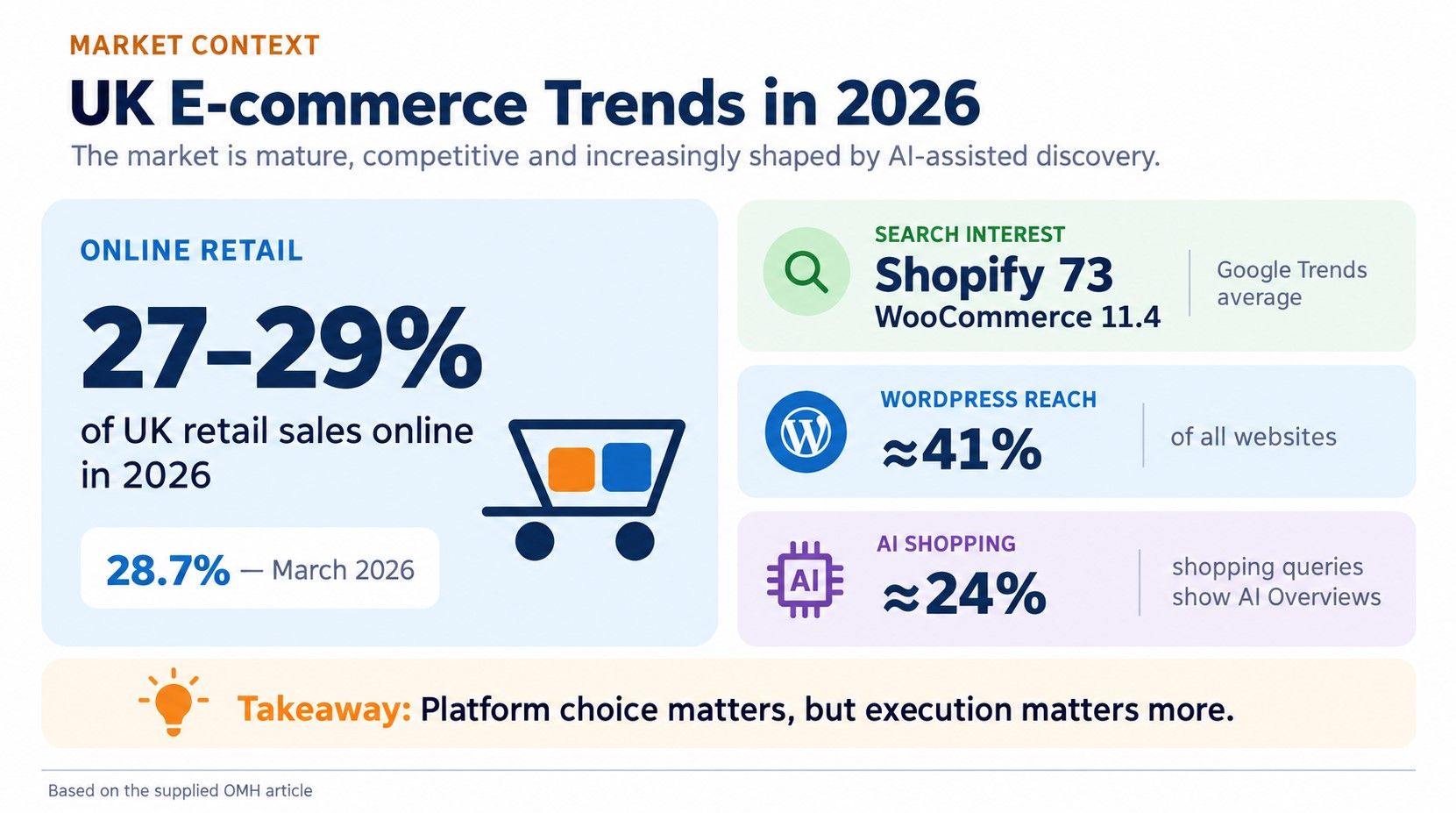
On Google Trends, Shopify pulls in far more search interest than WooCommerce. A Google Trends study of ecommerce platforms published in March 2026 found Shopify averaging 73 on Google's 0 to 100 interest scale worldwide, compared with 11.4 for WooCommerce, over a 30-day period. Shopify interest also hit its peak in every tracked region in mid-February 2026, shortly after the company's end-of-year results were announced.
A word of caution, though. Google Trends shows relative interest, not the number of shops. Shopify spends heavily on advertising, and thousands of merchants search "Shopify login" every single day. People running WooCommerce stores are more likely to search for "WordPress" or a specific plugin instead. So high search interest tells you about brand awareness, not which platform is better for your business.
You can check the current UK picture yourself in Google Trends. Set the location to the United Kingdom, choose "Past 5 years", and compare the terms as topics rather than plain search terms for a fairer reading.
2. WordPress is maturing, not disappearing
According to W3Techs, WordPress still runs around 41% of all websites and roughly 59% of sites that use a known CMS. Its share has slipped slightly, though. Search Engine Journal reported that it fell from 43.2% in December 2025 to 41.9% by May 2026, mainly because Shopify, Wix, and custom-built sites are growing faster. Shopify sits at roughly 5% of all websites.
When you look only at online shops, WooCommerce still powers more stores by count, while Shopify leads among the busiest, highest-revenue sites. Industry trackers put Shopify on around 29% of the top one million ecommerce sites compared with around 18% for WooCommerce. In other words, lots of small shops use WooCommerce, and a lot of fast-growing brands choose Shopify.
3. UK shoppers have settled into online buying
The Office for National Statistics shows internet sales making up roughly 27% to 29% of all UK retail sales through 2026 (28.7% in March 2026, for example). That share has held fairly steadily since mid-2024. The takeaway for store owners is simple: the market is big, but it is no longer growing by itself. You win customers by being faster, clearer, and easier to buy from than your competitors, and your platform choice plays a big part in that.
4. AI search is changing how products get found
This is the trend we are watching most closely for our e-commerce clients. Search Engine Land reported that Google AI Overviews would appear on about 24% of shopping searches by September 2026, up from roughly 1% in November 2025. Shopify also says that traffic from AI search tools to Shopify stores grew eight times year on year in early 2026.
Both platforms can do well here, but the stores that get cited by AI tools tend to have clear product data, proper structured data, and genuinely helpful content. We have written more about this in our guide to zero-click searches and AI Overviews.
What this means for you
Do not pick a platform because it is trending. Shopify's growth is real, and WordPress is far from finished. Pick the one that matches how your business sells, which is exactly what the rest of this guide will help you do.
Shopify vs WordPress UK at a glance#
| Comparison | Shopify | WordPress + WooCommerce |
|---|---|---|
| Type | Hosted (SaaS) | Self-hosted, open-source |
| Time to launch | Days to a few weeks | A few weeks to a few months |
| Platform cost | £19 to £259 a month (annual billing), plus from around £1,800 | Software is free; you pay for hosting, plugins, and upkeep |
| Hosting and security | Included | Your responsibility (or your agency's) |
| Transaction fees | None with Shopify Payments; 0.6% to 2% extra if you use another provider | None from the platform |
| Design freedom | Good, within theme limits. | Almost unlimited |
| SEO control | Good, with a fixed URL structure | Full control |
| Blogging and content | Basic | Excellent |
| Comparison | Shopify | WordPress + WooCommerce |
|---|---|---|
| Maintenance | Very low | Regular updates, backups, and checks needed |
| Ownership | You rent the platform. | You own the site and the data. |
| Best for | Product-led brands that want to sell quickly | Content-led stores and businesses needing custom features |
How much does each platform cost in the UK?#
Cost is usually the first thing people ask about, and it is also where the comparison gets misleading. Shopify's price is right there on the pricing page. WooCommerce is "free", but a working store is not. Let's break it down properly.
Shopify pricing in the UK (2026)
| Plan | Paid yearly | Paid monthly | Online card rate (Shopify Payments) | Fee if not using Shopify Payments |
|---|---|---|---|---|
| Basic | £19/month | £25/month | 2% + 25p | 2% |
| Grow | £49/month | £65/month | 1.7% + 25p | 1% |
| Advanced | £259/month | £344/month | 1.5% + 25p | 0.6% |
| Plus | From around £1,800/month | n/a | Negotiated | 0.2% |
Prices exclude VAT and were checked against Shopify's UK pricing page and independent UK sources in September 2026. At the time of writing, the £5 Starter plan is no longer open to new stores.
On top of your plan, most Shopify stores pay for a handful of apps (product reviews, subscriptions, advanced filtering, email marketing and so on), and many apps charge a monthly fee. A premium theme is a one-off cost, usually a few hundred pounds. If you sell to customers abroad, bear in mind that Shopify charges a currency conversion fee (currently 1.5%) when payments are converted.
WordPress and WooCommerce costs in the UK
- WordPress and WooCommerce software: free.
- Hosting: from around £10 a month for basic shared hosting, but for a store we would budget roughly £30 to £100 a month for good managed WooCommerce hosting. Cheap hosting is the number one reason we see slow, unreliable WooCommerce sites.
- Domain name: about £10 to £20 a year.
- Premium theme and plugins: many quality plugins charge an annual licence, often £50 to £300 a year each.
- Payment processing: no platform fee. Stripe's standard UK rate is 1.5% + 20p for standard UK cards, with higher rates for premium, business and international cards.
- Maintenance: updates, backups, security monitoring and fixes. You can do this yourself or use a WordPress website maintenance plan.
A worked example: a UK store turning over £10,000 a month
Let's say you sell £10,000 a month online, with an average order of £50 (200 orders), and most customers pay with standard UK cards.
| Monthly cost | Shopify (Grow, paid yearly) | WooCommerce |
|---|---|---|
| Platform or hosting | £49 | £40 (managed hosting) |
| Card processing | £220 (1.7% + 25p) | £190 (Stripe 1.5% + 20p) |
| Apps or plugin licences | £60 (typical app spend) | £25 (annual licences spread monthly) |
| Maintenance | Minimal | £75 (typical care plan) |
| Approximate total | £329 | £330 |
These are illustrative figures, and yours will differ depending on your apps, plugins, card mix, and hosting. The point is this: at this size, the costs often end up surprisingly close. The real difference is who does the work. With Shopify, the platform handles the technical side. With WooCommerce, you (or your agency) do. As turnover grows, WooCommerce's lower processing fees can start to save real money, while Shopify's higher plans reduce card rates to close the gap. If you want to see what our services cost, our price list is public.
Shopify vs WordPress for SEO: which ranks better?#
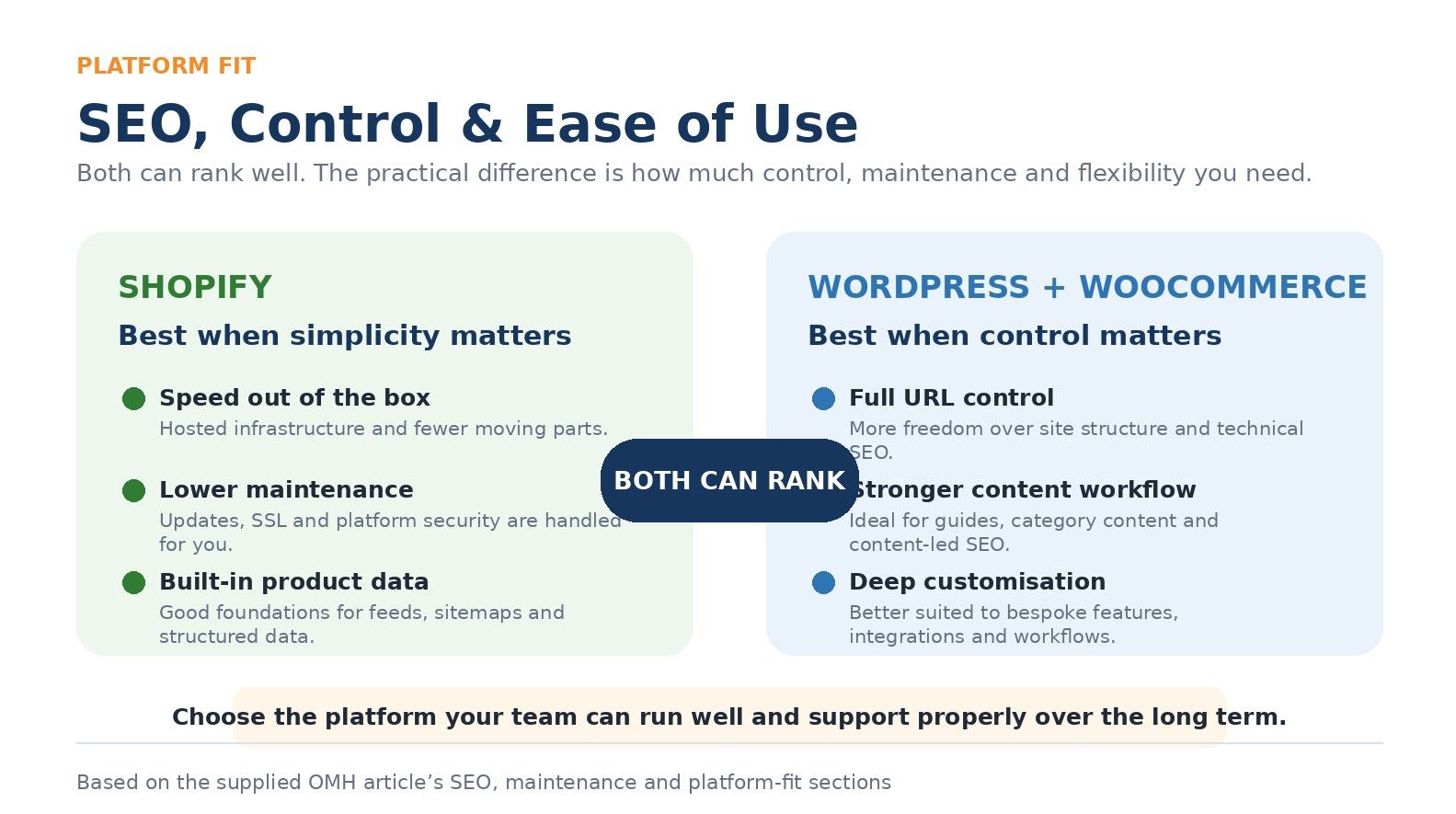
We get asked this constantly, and the honest answer is that both platforms can rank on page one of Google. We have seen well-optimised stores on both do very well, and badly set-up stores on both go nowhere. The platform matters less than what you do with it. That said, there are real differences.
Where WordPress has the edge
- Full control over URLs. You can use clean URLs like /garden-furniture/rattan-sofas/ rather than a fixed structure.
- Content marketing. WordPress started life as a blogging platform, and it is still the best tool for building guides, buying advice, and category content that ranks and gets cited by AI tools.
- Technical SEO. Plugins like Rank Math and Yoast give you detailed control over schema markup, canonical tags, sitemaps, breadcrumbs and redirects. Choosing a lightweight theme helps too; see our list of SEO-optimised WordPress themes.
Where Shopify has the edge
- Speed out of the box. Shopify runs on a fast global network, so a well-built Shopify theme usually performs well on Core Web Vitals with little effort. WooCommerce can be just as fast, but it depends on your hosting, caching, and plugins. A good content delivery network makes a big difference.
- Fewer things to break. No plugin conflicts, no forgotten updates, and far less chance of a technical SEO problem creeping in unnoticed.
- Product data built in. Shopify adds product structured data and XML sitemaps automatically, and its product feeds connect easily to Google Merchant Center.
Shopify's SEO limitations
Shopify forces a set URL structure (/products/, /collections/, /pages/ and /blogs/news/), and you cannot remove these prefixes. Its blogging tools are basic, and some advanced schema changes need apps or theme code. None of this stops a Shopify store from ranking, but it does give you less room to manoeuvre in competitive markets.
Our view: if organic search and content are going to be your main source of sales, WordPress gives you more room to grow. If your traffic will mostly come from Google Ads management, social media and marketplaces, Shopify's SEO is more than good enough. Either way, our SEO services cover both platforms.
UK-specific things you need to think about#
Most comparison articles are written for the US market. Here is what matters when you are selling from the UK.
VAT
Both platforms handle UK VAT rates and let you show VAT-inclusive prices, which UK consumers expect. You must register for VAT once your taxable turnover goes over the current threshold, which is £90,000 (see GOV.UK). If you sell to the EU, you will also need to think about the Import One Stop Shop (IOSS) for lower-value parcels. Shopify has more of this built in through Shopify Markets, while WooCommerce usually needs a tax plugin.
Payments UK shoppers expect
Apple Pay, Google Pay, PayPal and buy now, pay later options such as Klarna and Clearpay are available on both platforms, through Shopify Payments and apps on Shopify, or through plugins on WooCommerce. Shopify's checkout is well known for converting well because so many shoppers already have a Shop Pay account.
Delivery
Royal Mail Click & Drop, DPD, Evri and most UK couriers integrate with both platforms. If you rely on complex delivery rules (for example, different prices for Highlands and Islands postcodes or pallet deliveries), WooCommerce is often easier to customise.
UK GDPR and cookies
You need a proper cookie consent banner and privacy policy on either platform. Shopify includes a basic consent banner, while WordPress needs a consent plugin. The ICO has clear guidance on what UK businesses need to do.
Support
Shopify offers 24/7 support. WordPress has no central support team, so you rely on your developer, agency or hosting company. That is one reason many of our WordPress clients choose a care plan, so they have a UK-based team to call when something goes wrong.
Ease of use, design, security and growth#
Ease of use
Shopify is easier for most people. The admin area is clean, adding products is simple, and you cannot accidentally break the site. WooCommerce has a steeper learning curve because you are dealing with WordPress, WooCommerce, and several plugins, each with its own settings. Once it is set up properly, though, day-to-day tasks like adding products and processing orders are straightforward on both.
Design and customisation
Shopify themes look professional and are built for selling, but you work within what the theme and Shopify allow. WordPress gives you almost total freedom, especially with a page builder like Elementor. If your brand needs a distinctive look, or you want your shop to sit inside a larger content-rich website, WordPress makes that easier. Our website design team works on both.
Security and maintenance
This is where Shopify really earns its monthly fee. Hosting, SSL, PCI compliance for payments, and platform updates are all handled for you. WordPress is secure when it is looked after, but because it is so popular, it is also a big target for hackers, and outdated plugins are the most common way in. We have cleaned up enough hacked WordPress sites to know that skipping updates and backups is a false economy. If you choose WooCommerce, budget for proper maintenance from day one.
Growing your business
Both platforms scale. Shopify handles traffic spikes (think Black Friday) without you lifting a finger, and Shopify Plus is used by some very large brands. WooCommerce can handle large catalogues and high order volumes too, but it needs better hosting and more technical care as you grow. If you plan to sell on marketplaces, both connect to Amazon, eBay, and Etsy, and our Amazon PPC team works with sellers on either platform.
Who should choose Shopify?#
In our experience, Shopify is usually the right choice if:
- You want to launch quickly and start selling within weeks.
- You do not have (or want) a developer on call.
- Your sales will mainly come from paid ads, social media, or marketplaces.
- You sell physical products with fairly standard options such as size and colour.
- You expect traffic spikes and do not want to worry about hosting.
- You would rather pay a predictable monthly fee than manage updates and security yourself.
Who should choose WordPress with WooCommerce?#
WordPress with WooCommerce is usually the better fit if:
- Content and SEO will be a major source of customers.
- You already have a WordPress website and want to add a shop to it.
- You need custom features, such as product configurators, trade pricing, bookings, or memberships.
- You want complete ownership of your website, design and customer data.
- You sell a small number of high-value products where detailed content helps people decide.
- You have a developer or agency to look after the technical side.
Switching platforms without losing your rankings#
Already on one platform and thinking of moving? It can be done safely, but this is where we see the most costly mistakes. A migration done badly can wipe out years of Google rankings overnight. Before you switch:
- Crawl your current site and export every URL, including products, categories, blog posts, and images.
- Map each old URL to its new URL and set up 301 redirects. On Shopify, remember that product URLs must include /products/.
- Export customers, orders and reviews, and check what can and cannot be moved.
- Keep your page titles, meta descriptions and content the same at launch, then improve them afterwards.
- Test tracking (GA4, Google Ads conversions and Merchant Center) before you go live.
- Watch Google Search Console closely for the first eight weeks and fix any errors quickly.
If you would like a second pair of eyes, our free website audit is a good place to start.
Our verdict#
There is no single winner in the Shopify vs WordPress UK debate, and anyone who tells you otherwise is probably selling one of them. Here is how we sum it up for clients:
Shopify is the safer choice for most new and product-led UK stores. It is quicker to launch, easier to run and much less likely to go wrong, and you pay for that peace of mind every month.
WordPress with WooCommerce is the stronger choice when content, SEO and flexibility are central to how you win customers, and when you have the budget or support to look after it properly.
The best platform is the one your team can actually run well. A simple Shopify store that is updated regularly will beat a complicated WooCommerce build that nobody maintains, and the reverse is also true.
Frequently asked questions#
Is Shopify better than WordPress for SEO?
Not automatically. WordPress gives you more control over URLs, content, and technical SEO, which helps in competitive markets. Shopify is faster out of the box and harder to break. Both can rank well when they are set up and optimised properly.
Is WooCommerce really free?
The WooCommerce plugin is free, but running a store is not. You will pay for hosting, a domain, premium plugins or extensions, payment processing, and maintenance. For a small UK store, the total often ends up similar to a mid-range Shopify plan.
Which is cheaper for a small UK business?
For a brand-new store with low sales, a simple WooCommerce setup can be cheaper on paper. Once you add proper hosting and maintenance, Shopify's Basic or Grow plan is often similar in cost and takes much less time to manage. Work out the full monthly cost, including your time, before deciding.
Can I use WordPress and Shopify together?
Yes. Some businesses keep their main website and blog on WordPress and use Shopify for the shop, either with Shopify's Buy Button or with a link to a Shopify store on a subdomain. It works, but it does split your SEO authority across two sites, so it is not our first recommendation for most stores.
Which is better for dropshipping in the UK?
Shopify is generally easier for dropshipping because many supplier apps are built for it first. WooCommerce can do it too, with plugins, but it usually takes more setup.
Do I need a developer to build my store?
You can build a basic Shopify store yourself. A WooCommerce store is possible to build yourself too, but hosting, security, and performance are much easier to get right with experienced help. On either platform, a professional build usually pays for itself through better conversion rates and fewer problems later.
Need help choosing the right platform?#
At Online Marketing Help, we have been building websites and running digital marketing for UK businesses for over 15 years, and we work with both Shopify and WordPress every week. We will look at how you sell, your budget, and your plans for growth, and give you a straight answer, even if that answer is "stay where you are".
Book a free consultation with our team, or grab a free website audit, and we will show you exactly where your current store could improve. You can also browse our case studies to see the kind of results we get for clients.
Keep reading
Related insights
Websites & Ecommerce
5 Website Maintenance Tasks UK Business Owners Often Overlook
Most UK business websites miss these 5 website maintenance tasks. Learn what to check, how often, and how to avoid lost leads, hacks, and ranking drops.
Read articleWebsites & Ecommerce
How to Choose the Right Web Development Partner in the UK
Choosing a web development partner in the UK? Our 2026 guide covers real costs, red flags, contracts, questions to ask, and what Google Trends reveals.
Read articleWebsites & Ecommerce
How to Create a Profitable Membership Site with WordPress
Learn how to create a profitable membership site with WordPress, offering flexible, scalable solutions to generate reliable, recurring revenue.
Read articleTurn useful ideas into a practical growth plan.
Tell us what you want to improve and what you have tried so far. We will help you identify the clearest next step.
What happens next
- Review the current position
- Define the commercial objective
- Agree the work and measurement