

SEO8 min read
How AI Voice Agents Help UK Businesses Solve 5 Common Call Problems
Discover how AI voice agents help businesses reduce missed calls, answer after-hours enquiries, shorten hold times and capture more leads.
- Written by
- Melissa Cross
- Published
- 17 September 2026
- Updated
- 22 October 2026
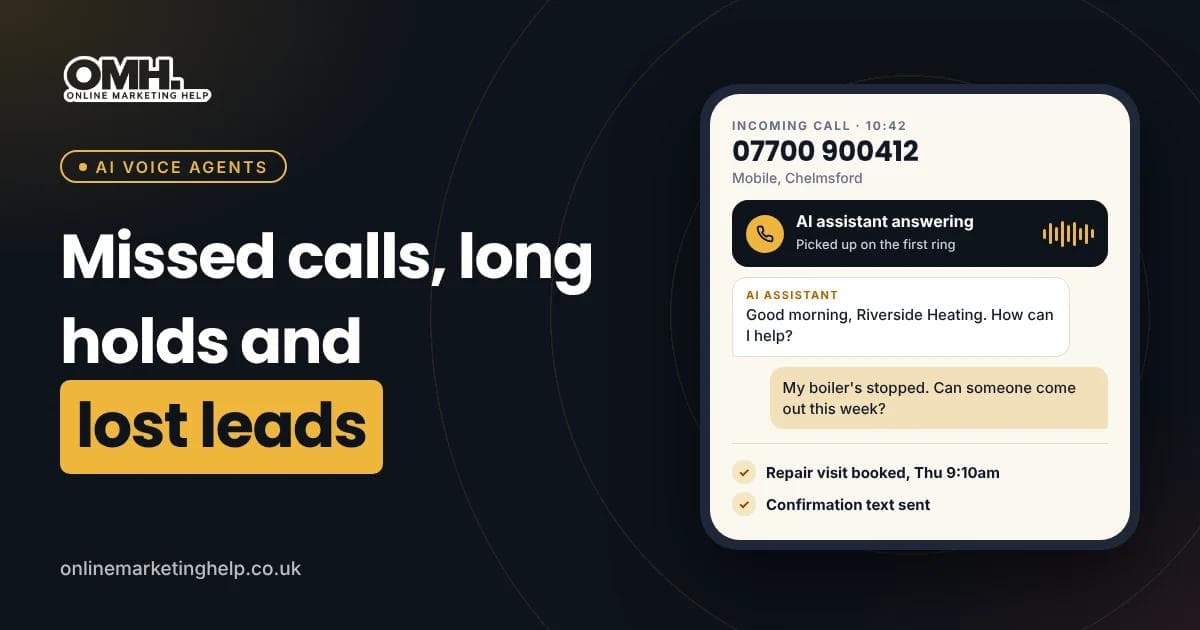
It's 10:40 on a Tuesday. A heating engineer in Chelmsford is mid-repair when his phone rings three times in 20 minutes. Nobody leaves a voicemail, and by lunchtime one caller has booked someone else.
That gap between a ringing phone and a free pair of hands is where the benefits of AI voice agents show up. Below, we cover five phone problems that cost UK businesses work, and when a voice agent isn't the right fit.
What is an AI voice agent?
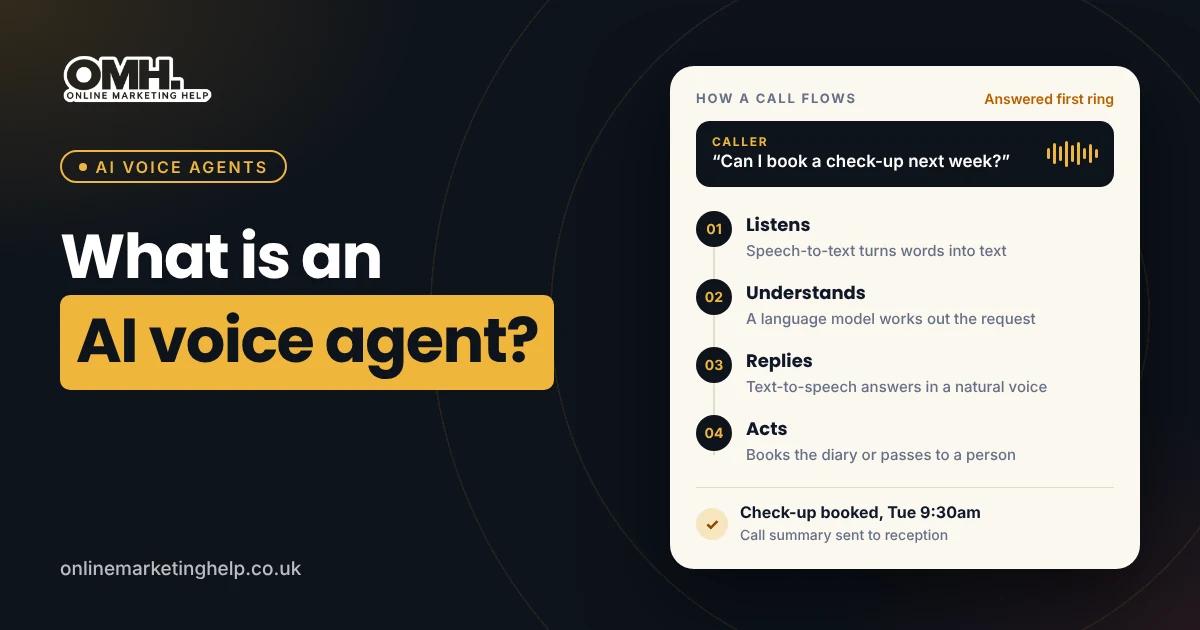
An AI voice agent (also called an AI receptionist or AI phone agent) is software that answers your business calls and talks to callers in natural speech. It works out what they want, replies from information you have approved, books appointments and sends your team a written summary.
Speech-to-text, a large language model (LLM) and text-to-speech let callers simply say what they need, with no IVR menu to press through. Around 35% of UK businesses with 10 or more employees now use some form of AI, up from about 12% in late 2023 (ONS, 2026).
Problem 1: What happens to calls you miss during the day?
Most calls you miss during the day are gone for good, because many callers hang up rather than leave a voicemail and ring the next business. An AI voice agent picks up when your team can't, so the caller gets an answer and you get the job details.
Problem 2: How do you handle calls after hours?
An AI voice agent answers at 8pm or on a Sunday just as it does at 11am. Evening and weekend callers can still book, get an answer or leave proper details, which matters because many people only ring around after work, when most small businesses have closed.
Genuine emergencies, like a winter no-heating call, can go straight to whoever is on call.
Problem 3: How can you cut hold times at busy periods?
An AI voice agent can handle multiple calls at once, so no one waits in a queue while a single receptionist works through them. It also answers routine questions about opening hours, prices, and directions, leaving your team free for the calls that need a person.
Even big telecoms providers kept callers waiting about two minutes on average in 2024, according to Ofcom's 2025 Comparing Customer Service report. One receptionist on a busy Monday will struggle to match that.
Problem 4: Why do phone enquiries become lost leads?
Phone enquiries become lost leads when details end up on a scrap of paper, sit in a voicemail inbox or never get a callback. An AI voice agent asks the same questions every call and sends the caller's details, reason for calling and urgency to your inbox or CRM straight away.
Over time, those summaries show why people ring you, which helps you generate more qualified leads from marketing you already pay for.
Problem 5: Are you paying for calls nobody answers?
If your ads, Google Business Profile or website send calls to a line that rings out, you are paying for enquiries you never hear. An AI voice agent answers those calls, so more of your budget turns into bookings instead of missed-call notifications.
Here's the thing: when someone taps the call button on a Google ad, you have usually paid for that click already. If you invest in Google Ads management services or local SEO services to bring in calls, answering them matters as much as generating them.
How does an AI voice agent compare with the alternatives?
An AI voice agent sits between voicemail and a full-time receptionist: it answers every call at any hour and books appointments, usually on a monthly plan. A good receptionist still wins on judgement and personal touch, so we recommend running an agent alongside your team.
| AI voice agent | Voicemail | Answering service | Receptionist | |
|---|---|---|---|---|
| Out of hours | Answers 24/7 | Message, if left | Depends on plan | Office hours only |
| Several calls at once | Yes | No | Depends on staffing | No |
| Books appointments | Yes, during the call | No | Sometimes | Yes |
| How you pay | Monthly plan plus minutes | Usually included | Per call or monthly | Salary plus employer costs |
| Best for | Routine and out-of-hours calls | Very few calls | Human message-taking | Complex calls, visitors |
| Main limits | Needs testing and monthly review | Callers may hang up | Limited business knowledge | Cost and holiday cover |
AI voice agent vs voicemail vs answering service vs receptionist
What are the benefits of AI voice agents, and where do they fall short?
The main benefits of AI voice agents are that more calls get answered and every enquiry is captured, without hiring extra staff. They fall short on calls that need expert judgement or empathy from the first sentence, and they need a regular review to stay accurate.
It's probably not worth it if:
- your phone is quiet and you already answer every call
- most calls need clinical, legal or financial advice
- you want callers to think they're talking to a human
- you want to set and forget it
What UK rules apply to AI voice agents?
The UK has no single AI law for phone calls, so voice agents fall under existing data protection and marketing rules. Call recordings and transcripts are personal data under UK GDPR, so you need a lawful basis, clear privacy information and a written agreement with your provider. Outbound marketing calls also fall under the Privacy and Electronic Communications Regulations (PECR).
Tell callers at the start that they're speaking to an AI and that the call may be recorded. The ICO's telephone marketing guidance requires specific consent for automated marketing calls and bars live ones to numbers on the Telephone Preference Service (TPS) without consent. Since 5 February 2026, under the Data (Use and Access) Act 2025, PECR fines can reach £17.5 million or 4% of global turnover (ICO, 2026).
This is general information, not legal advice. Check current ICO guidance for your situation.
How do you get started with an AI voice agent?
Start with the calls that hurt most, usually missed or out-of-hours calls, and hand those to an agent first. Test it before any customer hears it, then review real calls every month and improve the script. Five steps cover most setups.
- Check your call logs to see how many calls you miss, and when.
- List why people ring. Bookings, prices and opening hours are the easiest to hand over.
- Decide what goes to a person, such as emergencies, complaints and anyone who asks.
- Approve the script and connect your diary or CRM.
- Test, launch and measure calls answered, bookings made and calls transferred.
At Online Marketing Help, our Essex team follows this process when we build AI voice agents for UK service businesses.
Frequently asked questions
Can an AI voice agent use my existing number?
Usually, yes. Most setups divert calls from your current number to the agent, either every call or only those your team misses. Some businesses add a new local number for a campaign or branch. Your supplier can confirm what works with your phone system.
Will callers know they're talking to an AI?
They should. Best practice is for the agent to say it's an AI assistant in its greeting and mention if the call is recorded. Being upfront supports UK GDPR transparency and lets anyone who would rather speak to a person ask to be put through.
Can an AI voice agent replace a receptionist?
For most small businesses, no. An agent is best at routine and out-of-hours calls, while a good receptionist handles judgement calls and visitors. That fits UK data: the ONS (2026) found most businesses using AI report no change in headcount so far.
What happens if the AI doesn't know the answer?
A well-built agent says so instead of guessing. It answers only from information you've approved, so anything outside that becomes a message or a transferred call. Reviewing those moments each month shows you which answers to add next.
How much does an AI voice agent cost in the UK?
Costs depend on call volume, the systems the agent connects to and whether the service is managed or DIY. Pricing is commonly a monthly plan with included minutes, a per-minute rate above that and sometimes a setup fee. Weigh it against the jobs you currently miss.
Final thoughts
Missed calls, long hold times and lost leads usually share one cause: more calls than your team can answer when they arrive. The benefits of AI voice agents come from closing that gap, answering on the first ring and getting every enquiry to the right person. Start with the calls you miss most and measure what changes. For an honest second opinion on your phones, book a Growth Consultation with our team.
Keep reading
Related insights
SEO
How to Move from .org to .com Without Losing SEO Value
Move .org to .com without losing SEO value: our step-by-step guide to URL mapping, 301 redirects, .htaccess rules and Google's Change of Address tool.
Read articleSEO
Claude SEO Audit Skill: How Our AI SEO Audit Found Casino Spam That Semrush Missed
Our Claude SEO audit skill found casino spam Semrush and Screaming Frog missed. See how this AI SEO audit works, how we removed the spam and how to build your own.
Read articleSEO
What Is an AI Voice Agent? A Complete Guide for UK Businesses
What is an AI voice agent? See how AI voice agents answer calls and book appointments for UK businesses, plus costs, UK GDPR rules and when to use one
Read articleTurn useful ideas into a practical growth plan.
Tell us what you want to improve and what you have tried so far. We will help you identify the clearest next step.
What happens next
- Review the current position
- Define the commercial objective
- Agree the work and measurement