

SEO9 min read
What Is an AI Voice Agent? A Complete Guide for UK Businesses
What is an AI voice agent? See how AI voice agents answer calls and book appointments for UK businesses, plus costs, UK GDPR rules and when to use one
- Written by
- Melissa Cross
- Published
- 1 October 2026
- Updated
- 22 October 2026
It's 7pm on a Tuesday. Your team has gone home, and a new customer rings to book in. They reach voicemail, hang up, and call the next business on Google. You never find out the call happened.
That missed call is the problem an AI voice agent is built to solve. In this guide we explain what an AI voice agent is, how it works, what it costs, the UK rules that apply and how to tell if one suits your business.
What is an AI voice agent?#
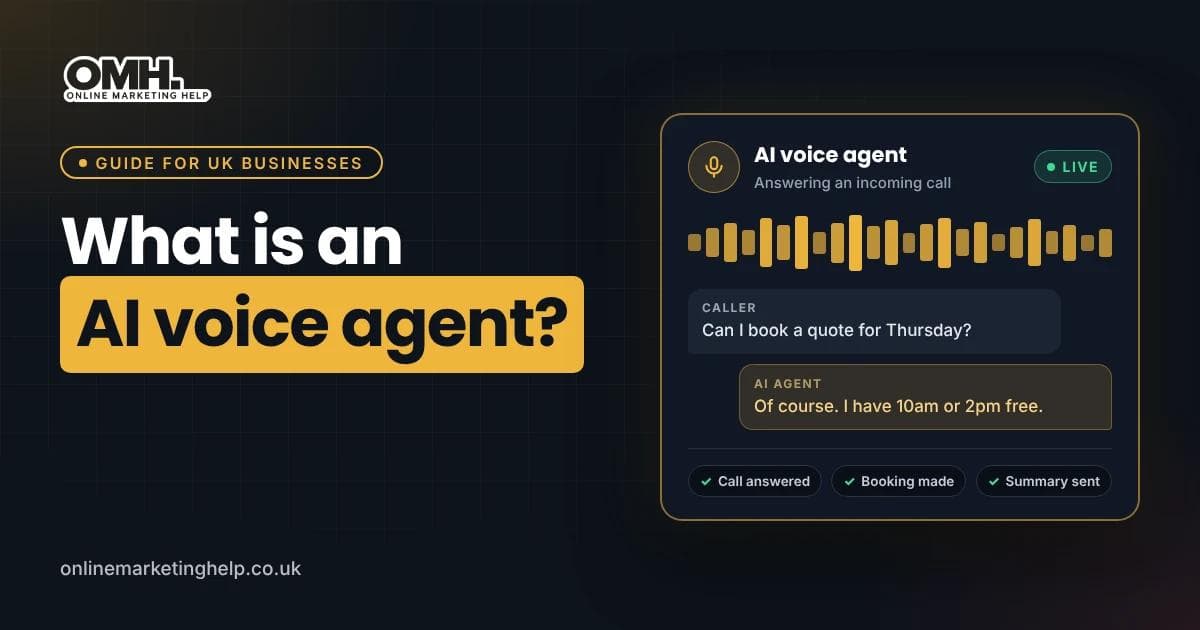
An AI voice agent is software that answers and makes phone calls for your business, talking with callers in natural speech. It works out what each caller needs, answers from information you have approved, books appointments into your diary and hands anything complex to a member of your team. It can work around the clock, including weekends and bank holidays.
How does an AI voice agent work?#
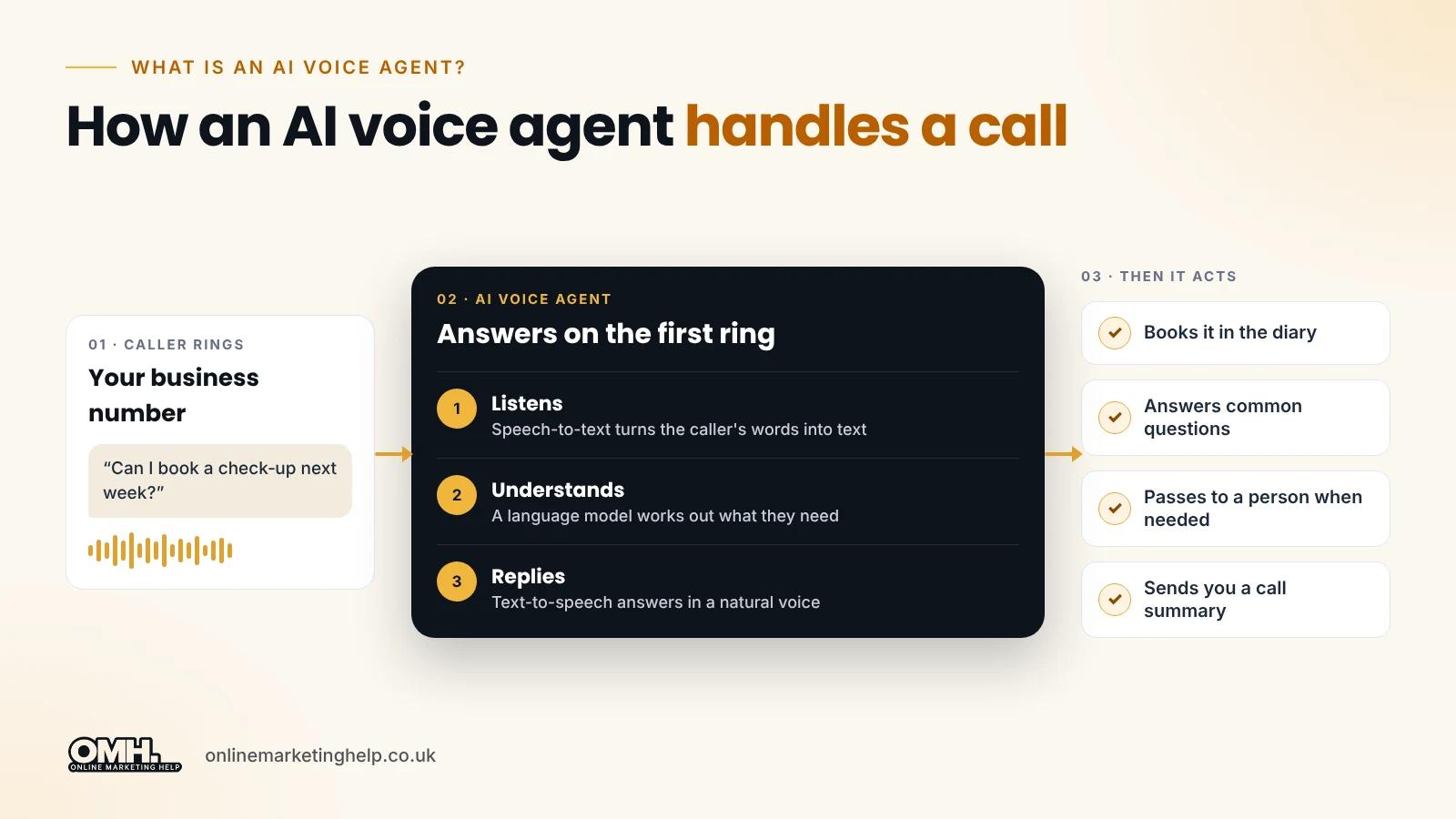
A voice agent combines a few technologies that work together in about a second:
- Speech recognition turns what the caller says into text.
- A large language model, the same type of AI behind tools such as ChatGPT, works out what the caller wants and chooses a reply. A well-built agent only uses the facts and rules you have signed off.
- Text-to-speech reads the reply aloud in a natural voice, with the accent and tone you choose.
- Integrations link the agent to your calendar, CRM or booking system so it can check availability and save the caller's details.
When the call ends, your team gets a written summary or transcript. Nobody has to chase a voicemail to find out what the caller wanted.
AI voice agent vs voicemail, IVR and chatbots#
People often mix these tools up. Here's how they compare.
| Option | What the caller gets | Books appointments? | Handles unexpected questions? |
|---|---|---|---|
| Voicemail | A recording, if they leave a message | No | No |
| IVR phone menu | "Press 1 for sales" style options | Rarely | No |
| Website chatbot | Typed replies on your website | Sometimes | Partly |
| AI voice agent | A spoken conversation on your phone line | Yes | Yes, within the limits you set |
The main difference is conversation. A caller can explain their problem in their own words instead of picking from a menu.
What can an AI voice agent do for your business?#
Most businesses use a voice agent for three jobs.
Answering calls you would otherwise miss
The agent picks up on the first ring, uses your business name and tells the caller they're speaking to an AI assistant. It can answer everyday questions about opening hours, prices, parking or what to bring to an appointment.
Booking and managing appointments
It checks real availability, offers times and books the slot while the caller is still on the line. It can also move or cancel bookings and send a text confirmation.
Follow-up calls
Appointment reminders, confirmations and call-backs to people who asked for one. Outbound calls come with extra legal rules, which we cover below.
How this looks in practice
- Dental and healthcare clinics: bookings and cancellations, with urgent calls sent to your emergency line. The agent never gives clinical advice.
- Plumbers and heating engineers: call-out details are taken while you're on a job, with no-heating emergencies put through to whoever is on call.
- Estate and letting agents: viewing requests captured on a Saturday when every negotiator is out.
- Law firms: new enquiries logged and existing clients routed to their solicitor. No legal advice is given.
- Car dealerships: test drives and service bookings taken during the morning rush.
We build and manage AI voice agents for UK businesses in each of these sectors, with every script based on the calls that sector actually gets.
Why UK businesses are adopting voice AI now#
AI use is growing quickly in the UK. According to the Office for National Statistics, the share of UK businesses with 10 or more employees using at least one AI technology rose from around 12% in late 2023 to around 35% by June 2026. Improving day-to-day operations is the most common use they report.
For phone-led businesses, the reason is simpler. You have often paid to make the phone ring. If you run call ads on Google, an unanswered call wastes the budget you've already spent. That's why we report voice agent call outcomes next to the results from our Google Ads management services, so you can follow an enquiry from the first click to a booked job.
A quick way to size the problem:
Missed calls a month x share of who would have booked x average job value = revenue at risk
Say you miss 40 calls a month, a quarter of those callers would have booked and an average job is worth £250. That's 10 jobs, or £2,500 a month, going to someone else. These figures are only an example, so check your phone provider's call log for your real numbers.
How much does an AI voice agent cost in the UK?
Prices vary by provider, but most UK plans follow the same pattern:
- A one-off setup fee for scripting, connecting your systems and testing
- A monthly fee that includes a set number of call minutes
- A per-minute rate for any calls over your allowance
DIY platforms cost less each month, but you write the script, connect the systems and fix problems yourself. Managed services cost more because someone else builds, tests and reviews the agent for you. Whichever route you take, weigh the price against what missed calls cost you now, and against options such as an answering service or extra reception cover.
UK rules: GDPR, call recording and PECR#
A voice agent handles personal data from the first call, so the law applies straight away. These are the points we check on every setup. Please treat this as general guidance, not legal advice.
- Tell callers they're speaking to an AI. Being open about how you use personal data is a core UK GDPR principle, and the ICO's guidance on AI and data protection covers transparency and fairness in detail. We also think it's simply the right thing to do.
- Explain recording and set retention. If you record or transcribe calls, tell callers at the start, decide how long you keep recordings and delete them on that schedule.
- Get the data roles in writing. You are normally the data controller. Your voice agent provider acts as your processor and should sign a data processing agreement. A data protection impact assessment (DPIA) before launch is good practice.
- Take care with outbound calls. Under PECR, automated marketing calls need the person's specific prior consent, and the ICO's telephone marketing guidance makes clear that general marketing consent isn't enough. The safest approach is to treat AI-led marketing calls as automated calls, only call people who agreed to hear from you and record opt-outs straight away.
- Stay within your sector's limits. Clinics and law firms should set the agent to handle practical questions only, never clinical or legal advice.
Both ICO pages are under review following the Data (Use and Access) Act 2025, so check the latest versions before you launch.
When a voice agent isn't the right fit#
We'd rather tell you now than three months in. A voice agent probably isn't worth it if:
- Your phone is quiet and you already answer every call
- Most calls need expert judgement from the very first sentence
- You want callers to think they're talking to a person (we won't build that)
- The line handles emergencies or safety-critical calls, where AI should never be the only route
- You want to set it up and forget it, because agents need a regular review to stay accurate
How to set up an AI voice agent the right way#
- Map your calls. Look at who rings, when and why, and how many calls you currently miss.
- Set the handover rules. Agree on which calls the agent handles and which always go to a person, such as complaints and emergencies.
- Approve the script. Write the greeting, choose the voice and load only the facts you're happy for callers to hear.
- Test before launch. Ring the agent yourself and try to trip them up. Fix what you find before any customer hears it.
- Start small, then review. Many businesses begin with out-of-hours calls and expand once the agent has proved itself. Listen to a sample of calls each month and improve the script.
A voice agent works best alongside your marketing#
A voice agent answers the phone. Something still has to make it ring. Paid search, the Google map pack and your organic rankings bring callers in, and the agent makes sure none of them end up in voicemail. If you want more calls in the first place, our local SEO services and professional SEO services are a good place to start.
Frequently asked questions#
Will callers know they're talking to an AI?
They should. We set every agent to say it's an AI assistant at the start of the call. It keeps you on the right side of transparency rules and avoids awkward moments later in the conversation.
Can an AI voice agent transfer calls to a real person?
Yes. You decide the rules, for example emergencies, complaints, existing clients or anyone who asks for a person. Outside your opening hours, it takes a detailed message for your team instead.
Can I keep my existing phone number?
In most cases, yes. You can divert calls to the agent, either all of them or only the ones your team can't answer.
Will an AI voice agent replace my receptionist?
For most businesses, no. It covers lunch breaks, busy periods, evenings and weekends, so your team can focus on the people in front of them. ONS figures also show that most UK businesses using AI haven't changed their headcount so far.
Keep reading
Related insights
SEO
How to Move from .org to .com Without Losing SEO Value
Move .org to .com without losing SEO value: our step-by-step guide to URL mapping, 301 redirects, .htaccess rules and Google's Change of Address tool.
Read articleSEO
Claude SEO Audit Skill: How Our AI SEO Audit Found Casino Spam That Semrush Missed
Our Claude SEO audit skill found casino spam Semrush and Screaming Frog missed. See how this AI SEO audit works, how we removed the spam and how to build your own.
Read articleSEO
Zero-click searches, AI Overviews and featured snippets: How to win position zero
Discover how to win Position Zero on Google by mastering zero-click searches, AI Overviews, and featured snippets. Boost visibility and drive traffic with smart SEO strategies.
Read articleTurn useful ideas into a practical growth plan.
Tell us what you want to improve and what you have tried so far. We will help you identify the clearest next step.
What happens next
- Review the current position
- Define the commercial objective
- Agree the work and measurement