

Websites & Ecommerce2 min read
Google Ads: How to Add Your Agency to Google Ads
This article will show you how to set up Google Analytics 4 on your WordPress website. The installation of GA4 is broken down into a few straightforward stages.
- Written by
- Melissa Cross
- Published
- Updated
Objective:
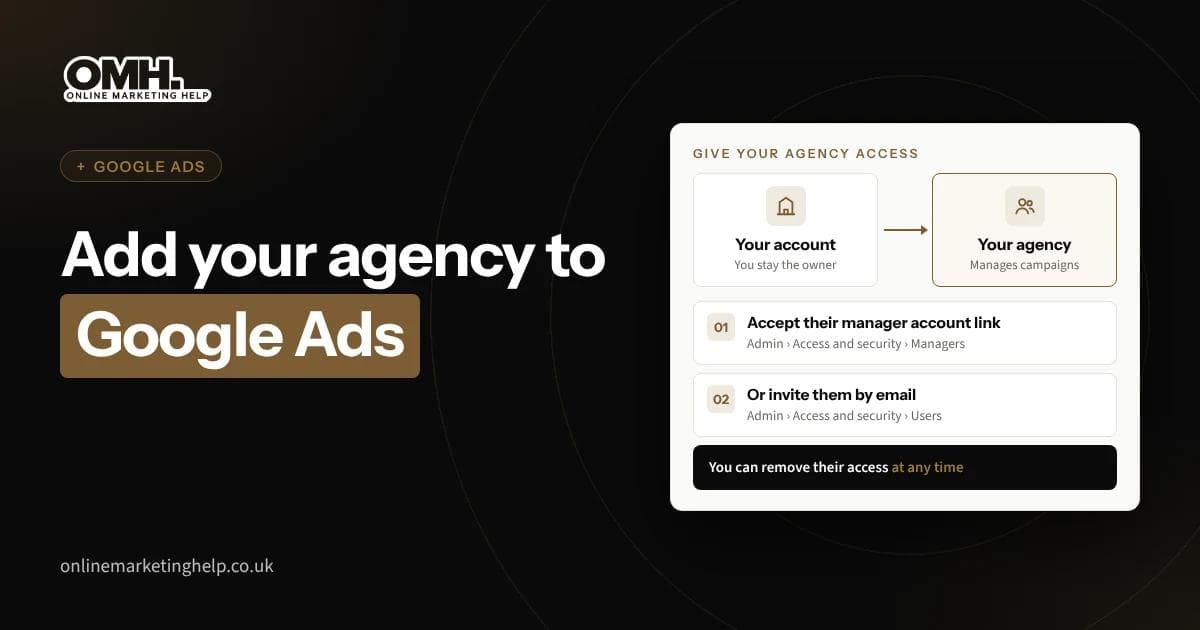
To provide a detailed, step-by-step guide for clients on how to grant an agency access to their Google Ads account. This ensures the agency can manage and optimise advertising campaigns effectively.
Instructions:
Step 1: Sign in to Google Ads
- Visit Google Ads: Open your web browser and go to Google Ads.
- Log in: Enter your Google account email and password associated with your Google Ads account.
Step 2: Access Account Settings
Navigate to Tools & Settings: In the upper right corner of the Google Ads interface, click on the wrench (Tools & Settings) icon.
Step 3: Go to Account Access
Account Access: Under the "Setup" column, click on "Access and security".
Step 4: Add New User
Add User: In the "Access and security" page, click on the blue “+” icon to add a new user.
Step 5: Enter User Details
- Enter Email Address: In the "Add new user" panel, enter the email address of the agency you wish to grant access to.
- Select Access Level: Choose the appropriate access level for the agency. The options are:
- Admin: Full access to the account including managing users.
- Standard: Can manage campaigns but cannot manage users.
- Read-only: Can view but not make changes.
- Email-only: Can receive notifications but has no access to the account.
Step 6: Notify New User
- Notification: Ensure the checkbox for "Send an invitation email" is checked. This will send an email to the agency informing them of their new access.
Step 7: Confirm and Send Invitation
Send Invitation: Click on the "Send invitation" button to finalise the process.
Step 8: Confirm and Add
Add User: Click on the "Add" button to grant access.
Conclusion
By following these steps, you will successfully grant your agency access to your Google Ads account, allowing them to manage and optimise your advertising campaigns effectively.
We hope this article will help you. To get connected please connect to our Facebook and Twitter.
- Written by
- Melissa Cross
- Published
- Updated
Related topics
WordPress
Keep reading
Related insights
Websites & Ecommerce
What to do after malware removal: 11 steps to stay clean
Your website is clean again, but most reinfections come from what the cleanup left behind. Here is what to do next, in order, from backdoors and passwords to Google warnings and UK reporting rules.
Read articleWebsites & Ecommerce
Website caching explained: what to cache and what to exclude
Caching makes WordPress pages faster by reusing a ready copy, but cache the wrong page and customers see old prices or someone else's basket. Here is what to cache, what to exclude and how to check it works.
Read articleWebsites & Ecommerce
How I Built a Beautiful Landing Page with Claude (and What AI Couldn’t Do)
See how I built a beautiful landing page with Claude: the brief, prompts, design tips and UK rules to check before launch. Read the step-by-step guide.
Read articleTurn useful ideas into a practical growth plan.
Tell us what you want to improve and what you have tried so far. We will help you identify the clearest next step.
What happens next
- Review the current position
- Define the commercial objective
- Agree the work and measurement
Ring it from any phone
It's set up as a fictional heating company in Leeds and answers day and night. Standard call rates apply.
The demo line is being set up.Book a demo and we'll play you one on the call.
Three things to try
- 1Book a boiler service for next week.
- 2Ask to speak to a person.
- 3Ask something it can't know, and hear how it handles it.