

Strategy & Measurement15 min read
Protect Your Website from Hackers: UK Small Business Guide
Most hacked small business websites fall to a handful of avoidable gaps. Here is what actually stops them, in what order, what it costs, and what UK law expects of you if it goes wrong.
- Written by
- Melissa Cross
- Published
- Updated
If you own a small business website, there is a fair chance something has already tried to break into it this week. Nearly all of it is automated and nearly all of it fails. The attempts that work usually get in through a gap the owner never knew was there.
We build and look after websites for UK businesses, including the WordPress maintenance plans that handle the updates and backups described below. We also clean up sites after they have been hacked, which is the more expensive way to learn this. So what follows is the advice we give our own clients.
Quick answer:
- Keep every piece of software on the site updated within days, not months.
- Put two-factor authentication and a unique password on every admin account, your hosting panel and your domain registrar.
- Take backups that live somewhere other than the site, and restore one to prove it works.
Those three things stop most of the attacks that hit small business sites. Then write down what you will do in the first 72 hours if one gets through, because UK law puts a clock on it.
How often do UK businesses actually get attacked?
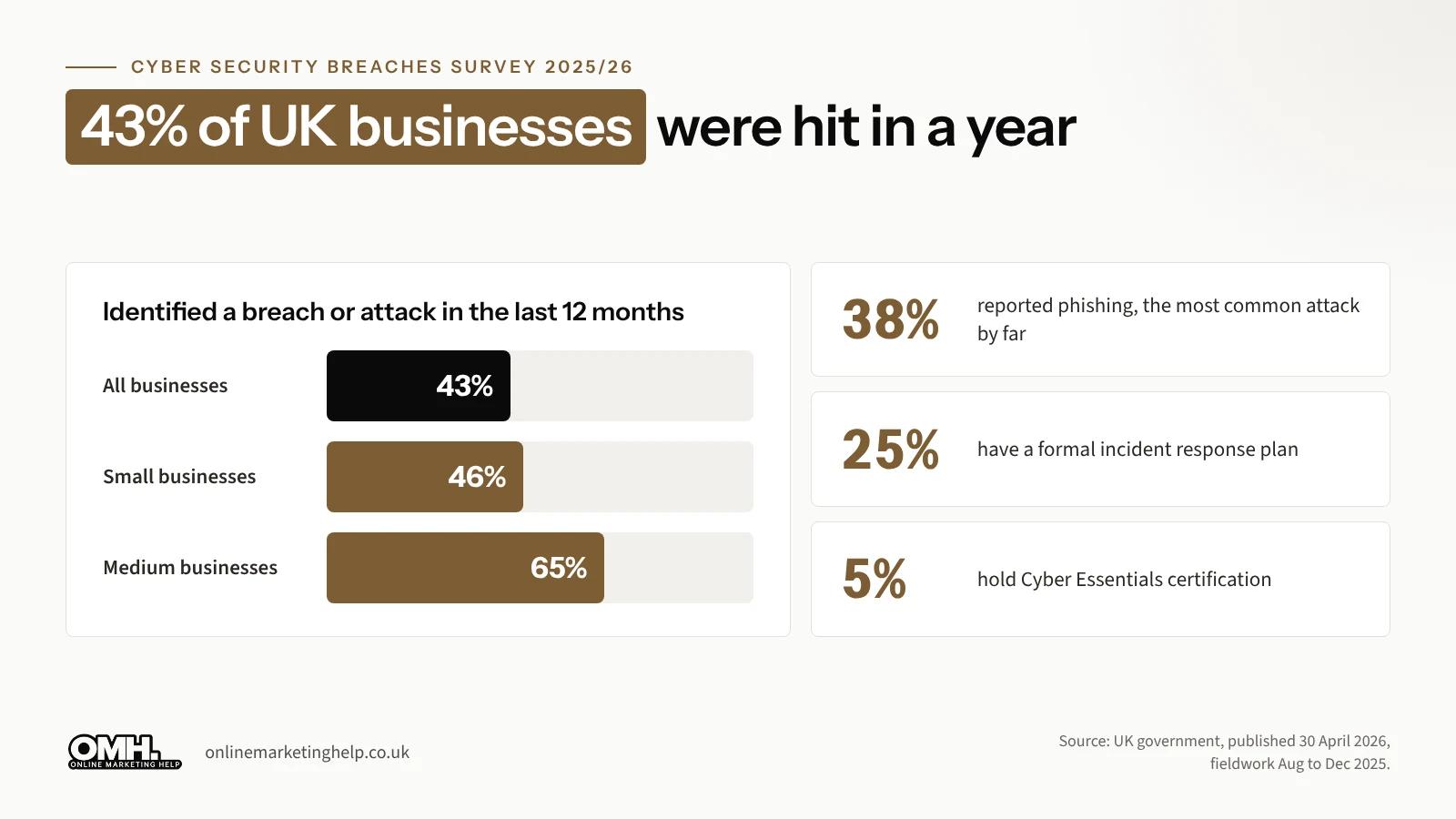
More often than most owners think, and the government measures it every year. The figures below come from the Cyber Security Breaches Survey 2025/26, published on 30 April 2026 from fieldwork between August and December 2025, unless marked otherwise.
- 43% of UK businesses identified a cyber breach or attack in the previous 12 months. For small businesses it was 46%, and for medium sized firms 65%
- Phishing was the most common attack by far, reported by 38% of businesses. For a website, that usually means someone on your team typing a password into a fake login page, and that same password opens the site
- Only 25% of businesses have a formal incident response plan, and only 5% hold Cyber Essentials certification
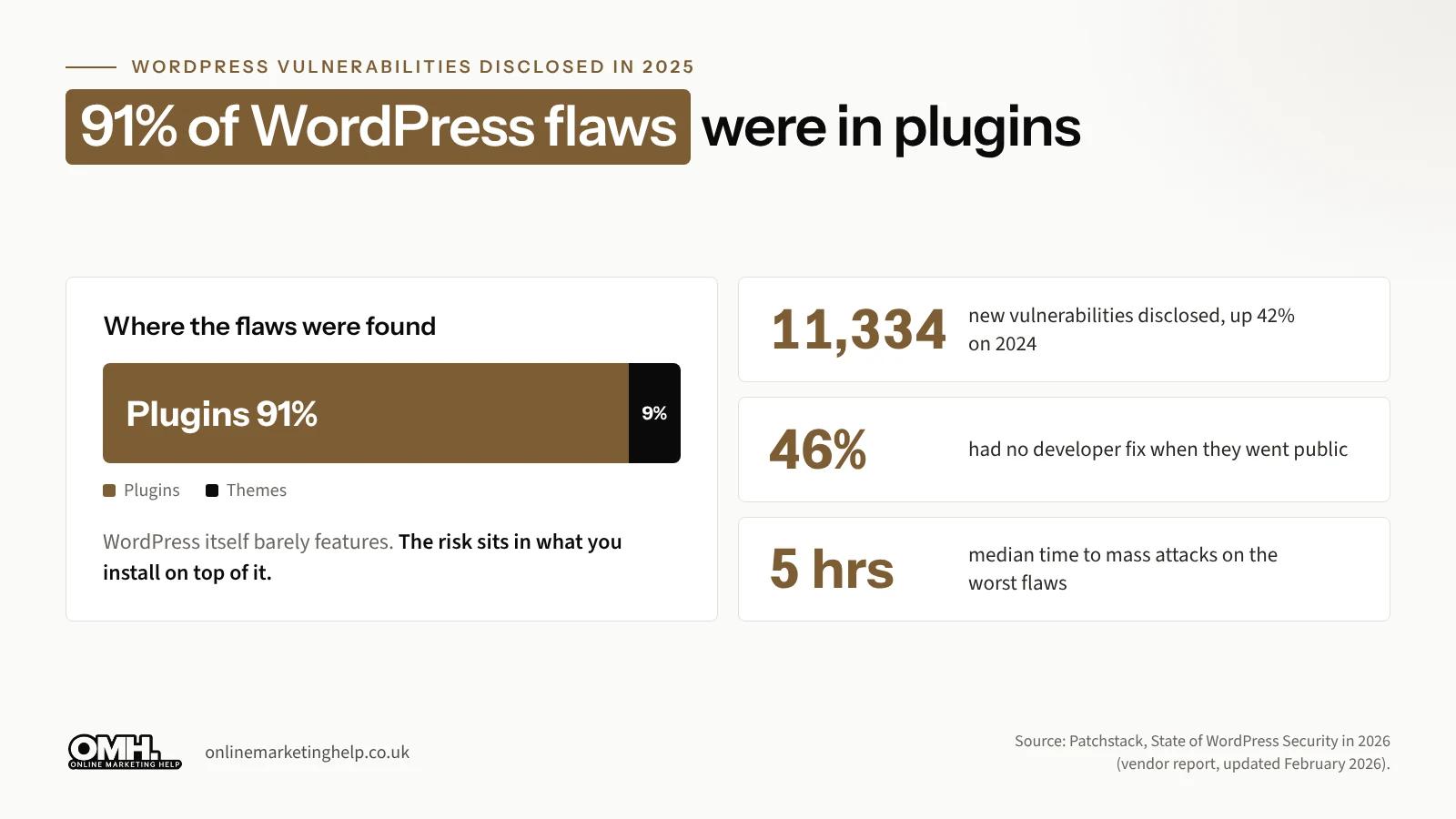
- 11,334 new WordPress vulnerabilities were disclosed in 2025, up 42% on 2024, and 91% of them were in plugins rather than WordPress itself, according to Patchstack's State of WordPress Security in 2026 (updated February 2026). Patchstack sells security tooling, so treat the total as their count, but the direction is not in dispute
A word of caution on the first figure. The survey asks businesses what they identified, so firms with no monitoring under-report. The real number is probably higher, not lower.
How do websites get hacked in the first place?
Almost never by a person sitting at a keyboard targeting you. Most attacks are scripts that scan millions of sites for one known weakness, and yours is hit because it matched, not because anyone chose you.
The weakness is usually one of four things. A plugin or theme with a published flaw that has not been updated. A password that was reused somewhere else and leaked. An admin account that belonged to a former employee or old agency and was never removed. Or a hosting account where one neglected site infects every other site on the same account. Securing a website starts with knowing which of these gaps applies to yours.
Patchstack's report gives a sense of the speed. For the most heavily exploited flaws of 2025, the median time from public disclosure to mass exploitation was five hours, and 46% of vulnerabilities had no developer fix available when they were disclosed. So "I update the site once a quarter" means you are unprotected for most of the year, and a plugin nobody maintains anymore can't be fixed at all. Picture a contact form plugin last updated in 2023, still switched on, on a site that otherwise looks fine. That is the open window.
Security reports name the attacks in jargon. Here they are in plain English, with the step further down that stops each one.
| Attack | What it means | What stops it |
|---|---|---|
| Brute force | A bot tries thousands of passwords on your login page | Steps 3 and 4 (2FA, login limits) |
| Phishing | Someone is tricked into typing a password into a fake page | Steps 3 and 9 (2FA, email records) |
| Plugin or theme exploit | A published flaw in out of date software | Steps 1 and 2 (remove, update) |
| SQL injection | Code typed into a form or web address makes your database hand over or change data | Steps 2 and 10 (updates, firewall) |
| Cross-site scripting (XSS) | Code planted on your pages runs in visitors' browsers, often to steal logins or redirect them | Steps 2 and 10 |
| Malicious file upload | A form that accepts attachments is used to upload a script | Step 10 (upload rules) |
| DDoS | A flood of fake traffic knocks the site offline | Step 10 (traffic filtering) |
And what do attackers want from a small business site? Rarely your data alone. Hacked sites get used to host spam pages, redirect visitors, send phishing emails, mine cryptocurrency on your server or attack other sites. Yours is useful to them because people trust it, not because it is famous.
What does a hack do to your Google rankings?
It can hurt your search visibility for weeks after the site is clean, and the hosting company guides rarely mention it. Hackers often add spam pages or links to a site. Google's Security Issues report in Search Console lists that as hacked content, alongside malware and social engineering (pages that trick visitors into handing over details).
Once Google flags a page, it can carry a warning label in search results. Visitors may also hit a full page warning in their browser before they reach it. Either one kills clicks.
Getting the warning lifted is a job in itself. You fix every listed issue on every affected page, press Request Review and explain what you did. Google says reviews typically take a few days to a few weeks.
So verify your site in Search Console now, before anything goes wrong, because you can only see the report for a site you have verified. And if your rankings fall and you cannot see why, check that report first. If you need help getting them back afterwards, that is part of our SEO work.
What security plugins and firewalls do well, and what they cannot stop
A good security plugin or web application firewall is worth having. It is not the whole answer, and the sales pages do not tell you where it stops. For website security for small business owners, knowing the limits matters as much as knowing the features.
What they handle well
- Blocking repeated login attempts and known bad IP addresses
- Catching the injection attacks that scanners throw at every site
- Virtual patching. Some firewalls push out a rule that blocks a known attack on a plugin before its developer has released a fix. That is the only cover you have for the 46% of flaws with no fix at disclosure, so ask whether yours does it. If it does not, deactivate or replace the plugin until the fix lands
- Scanning files for malware and flagging changed core files
- Keeping a log
What still needs a person
- Broken access control, which Patchstack names as the most exploited type of flaw in 2025 and which firewalls struggle to catch, because the request looks legitimate
- Phishing. No plugin stops your bookkeeper from typing the admin password into a fake login page
- Removing old accounts, abandoned plugins and test sites, which is a decision rather than a scan
- Your domain registrar and DNS. If someone takes over the domain, the site itself can be spotless and still point somewhere else
- Deciding whether a breach is reportable. Software cannot do that for you, and the ICO expects you to
If a provider tells you their plugin makes a site unhackable, that is the moment to stop listening.
What does protecting a website cost?
Less than people fear, and most of the bill is time rather than money. The table below is what a typical UK small business site needs. Where we show a price it was checked on the seller's own page in October 2026 and excludes VAT.
| Measure | Typical cost | Time and who does it |
|---|---|---|
| Two-factor authentication | Free | 10 minutes per account, you |
| Password manager | Free tiers exist, paid plans vary | An afternoon to move everyone over |
| Updates and off-site backups | Included with good hosting or a care plan | Weekly if you do it yourself |
| Security plugin or firewall | Free versions available, paid tiers vary | An hour to set up, then review the log monthly |
| Cyber Essentials certification | £320 plus VAT a year for 0 to 9 staff (IASME, October 2026) | A self-assessment, renewed annually |
| Cleaning up after a hack | Varies with the damage, plus lost trade | In our experience, a specialist working under pressure |
A worked example. A ten person firm with a WordPress brochure site does everything in the first five rows itself. The only invoice is Cyber Essentials at £320 plus VAT, so £384 a year, and the rest is a few hours of staff time. If they would rather not own the weekly updates and backups, that is what a maintenance plan is for, and our price list has the current figures.
Which protection should you do first?
Do them in the order below. The first four are the quick answer, row by row, and they stop most attacks on small business sites, and the last four are the ones most guides skip.
| Order | Measure | What it stops |
|---|---|---|
| 1 | Update within days, remove what you do not use | The automated scans that find last week's plugin flaw |
| 2 | 2FA on admin, hosting and registrar | A leaked or phished password being enough on its own |
| 3 | Unique passwords in a manager | One breach elsewhere opening your site |
| 4 | Off-site backups, restore tested | A hack becoming a rebuild |
| 5 | Audit admin accounts quarterly | An ex-employee or old agency login being the way in |
| 6 | Lock the domain, add SPF, DKIM and DMARC | Your domain being taken, or criminals emailing as you |
| 7 | One site per hosting account, no stale test sites | A forgotten staging copy infecting the live site |
| 8 | A written 72 hour plan | Panic, and a missed ICO deadline |
Protecting your website from hackers, step by step
Each step below says what done looks like, because "we have a security plugin" and "we are protected" are not the same sentence.
1. List what is installed and remove what you do not use
Every plugin, theme and integration. Done means nothing on the list has gone more than a year without an update from its developer, and anything you cannot name a reason for is deleted, not just deactivated.
2. Turn on automatic updates, or book a weekly slot
The test: a plugin flaw disclosed on Monday is patched on your site by Friday. Our WordPress maintenance service exists because most owners cannot keep this promise themselves, and that is a fair thing to admit.
3. Put 2FA on every account that can change the site
WordPress admin, hosting control panel, domain registrar, and the email address those accounts reset through. The NCSC's advice on email passwords is blunt: email is the key to everything else, so it gets a unique password and 2-step verification first.
4. Limit login attempts and move the login page
Set the site to lock someone out after three failed logins, for a short spell rather than for good, so a colleague who mistypes can try again later. Most security plugins and many hosts can do this, and it stops bots working through thousands of passwords.
Moving the login page away from the default address (/wp-admin or /wp-login.php on WordPress) cuts that bot traffic further. But a hidden address only hides the door. Treat it as an extra on top of 2FA, never instead of it, and write the new address down where your team can find it.
5. Move every login into a password manager and stop reusing
When it is done, no password appears twice, and nobody on the team knows the admin password by heart.
6. Audit the user list
Done means every admin account belongs to a named person who still works with you, and former staff and former agencies are gone. In our experience, this is the step most often left open when an old agency built the site.
7. Set up backups that leave the server, then restore one
A backup stored on the same hosting account dies with it. You are done when you have watched a copy of the site come back up on a staging domain from last week's backup. Until you have done that, you have a file, not a backup.
8. Lock the domain and check who can touch DNS
Turn on the registrar's transfer lock, add 2FA, and make sure the renewal card is not an ex-employee's. A lapsed domain is the quietest way to lose a website.
9. Set up SPF, DKIM and DMARC on your domain
These DNS records tell other email servers which senders are really you, so criminals find it much harder to send phishing emails that look like they came from your business. The NCSC's email security guidance says to start DMARC on a policy of "none", which reports problems without blocking anything, then tighten it. Done means a DMARC checker shows all three records on your domain.
10. Add a firewall or security plugin and read its log monthly
A service in front of the site, such as Cloudflare, or your host's own firewall can also filter floods of fake traffic (a DDoS attack) before they reach the server. If any form accepts file uploads, limit it to the file types you need, cap the size and scan what comes in. It only counts if someone opens the log, sees what was blocked, and knows what normal looks like for your site.
11. Write the 72 hour plan on one page
Who you call, where the backups are, how to put the site into maintenance mode, and the ICO's number. The next section covers what goes in it.
What UK rules apply if your website is hacked?
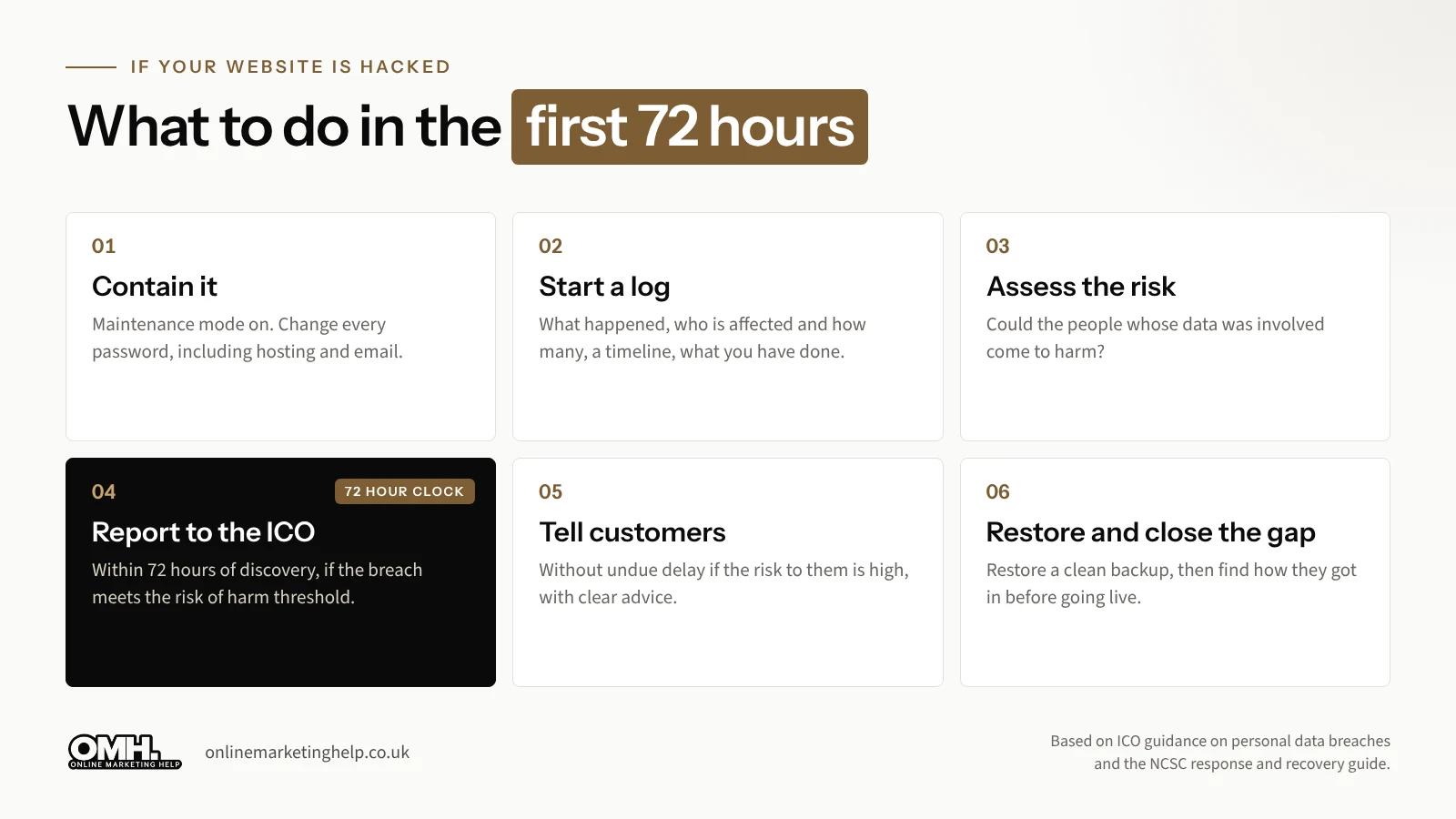
A hacked site can be a legal problem as well as a technical one. If it held or passed on customer data, UK GDPR starts a clock, and the ICO's own 72 hours guide is the plain English version of what follows.
When you have to report it
You must report a personal data breach to the ICO within 72 hours of discovering it, if it meets the threshold of a risk of harm to the people affected. The clock runs from discovery, not from the attack. A defaced homepage with no customer data behind it may not be reportable at all. A hacked booking form or shop almost certainly is.
What to write down, even if you do not report
Start a log from the first hour: what happened, who is affected and how many, a timeline, and what you have done. The ICO asks for this if you report, and it is what you will need for your insurer and your own peace of mind if you do not.
Telling your customers
If the risk to them is high, for example card details or login credentials, you must tell them without undue delay and give them specific advice such as changing passwords. If the risk is low you are not obliged to, but weigh the benefit of telling them against the worry it causes.
Containing it, in order
The NCSC's response and recovery guide runs prepare, identify, resolve, report, learn. For a website it goes like this. Maintenance mode on, change every password including hosting and email, restore from a clean backup, then find and close the gap before you switch the site back on. Restoring without finding the gap just books the same hack for next month.
Frequently asked questions
Is a free SSL certificate enough, or do I need to pay for one?
For a brochure site or a standard shop, the free certificate most hosts now provide gives the same encryption as a paid one. Paid certificates mainly add warranty and extended validation. SSL protects data in transit between the visitor and the server. It does nothing to stop a plugin flaw or a stolen password, which is where most small business hacks start.
My site is on Shopify or Wix. Does any of this apply?
Less of it, which is one reason people choose a hosted platform. The platform handles core updates, hosting and much of the firewalling. You still own the admin passwords, 2FA, the domain registrar, the staff accounts and the apps you install, and phishing works just as well against a Shopify login. We build on Shopify as well as WordPress, so we have no reason to push you either way.
How do I know if my website has already been hacked?
Common signs are new admin users you did not create, pages or links you did not add, your site appearing in Google with spam titles, visitors reporting redirects to other sites, or a browser warning on your own domain. A security plugin's file change report and the Security Issues report in Google Search Console are the quickest checks. If in doubt, our free website audit looks at this alongside speed and search.
Do I need Cyber Essentials for a small website?
Not for the website alone. Cyber Essentials covers your whole business, from laptops to email, and only 5% of UK businesses held it in the 2025/26 government survey. It becomes worth the £320 plus VAT when a client or contract asks for it, or when you want an outside checklist that forces the basics to happen every year. If a client wants more proof, Cyber Essentials Plus adds an independent technical check. A full penetration test (a paid specialist trying to break in) is worth it for sites that take payments or hold sensitive data.
How often should I back up and update?
Back up as often as the site changes. A shop taking orders needs daily backups at least, and a brochure site that changes monthly can live with weekly, as long as copies leave the server. Update within a week of a release, and the same day for anything marked as a security fix. The five hour median to mass exploitation in Patchstack's 2025 data is the reason.
Where to go from here
We build and look after websites for UK businesses. Our care plans exist so the weekly updates and tested backups above happen without you having to think about them. If you would like someone to check your site against this list, book the free website audit, or have a free consultation if you suspect something has already gone wrong. Our case studies show the kind of sites we look after.
Keep reading
Related insights
Strategy & Measurement
How to Set Up an AI Receptionist: DIY vs Managed
Three ways to set up an AI receptionist for a UK business: a ready-made app, your own build on a voice platform, or a managed service. Real costs in pounds, eight setup steps and the UK GDPR rules to follow.
Read article
Strategy & Measurement
How Digital Marketing Is Transforming the Way We Shop for Ceiling Lamps
Discover how digital marketing is changing how Argentinians shop for ceiling lamps online. Learn tips for SEO, social media, and sales growth.
Read article
Strategy & Measurement
Maximising ROI with Targeted Marketing Strategies
Maximising ROI with targeted marketing strategies. Learn expert tips to optimise campaigns & drive results.
Read articleTurn useful ideas into a practical growth plan.
Tell us what you want to improve and what you have tried so far. We will help you identify the clearest next step.
What happens next
- Review the current position
- Define the commercial objective
- Agree the work and measurement
Ring it from any phone
It's set up as a fictional heating company in Leeds and answers day and night. Standard call rates apply.
The demo line is being set up. Book a demo and we'll play you one on the call.
Three things to try
- 1Book a boiler service for next week.
- 2Ask to speak to a person.
- 3Ask something it can't know, and hear how it handles it.